
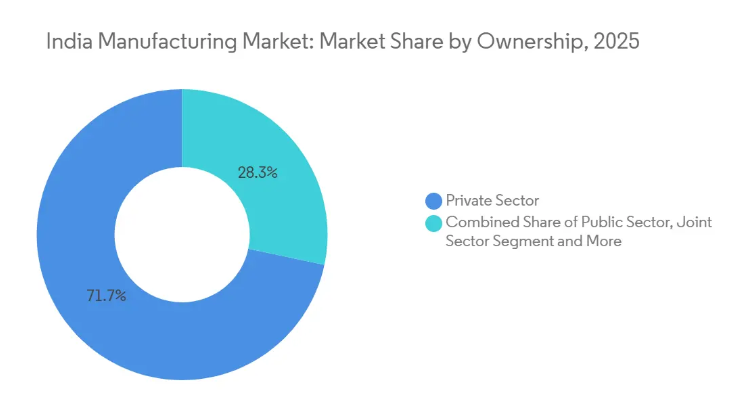
India’s manufacturing sector is entering a transformative growth phase, with the market reaching $1.74 trillion in 2026 and projected to expand to $2.47 trillion by 2031, representing a compound annual growth rate (CAGR) of 7.26%. This acceleration is driven by a convergence of policy support, foreign direct investment, and technological modernization.\n\n## Strongest Quarter Performance\n\nRecent quarter-on-quarter data reveals the sector’s momentum. Manufacturing GVA growth stood at 7.72% in Q1 FY 2025-26 and accelerated to 9.13% in Q2, indicating consistent expansion. The Manufacturing Purchasing Managers’ Index (PMI) has remained firmly in expansion territory since March 2023, with January 2026 readings at 55.4—well above the long-run average and signaling robust manufacturing activity.\n\nThis performance is particularly significant given global economic uncertainties. While some markets face stagflation risks, India’s manufacturing engine continues to fire on all cylinders, supported by broad-based demand from domestic consumption and export markets.\n\n## Policy Engines and Investment Catalysts\n\nThree major factors are driving this growth trajectory:\n\n**1. Production-Linked Incentive (PLI) 2.0**: With $26 billion in government support, PLI 2.0 targets high-value manufacturing in electronics, batteries, semiconductors, and green hydrogen. The scheme has already attracted significant private investment and is reshaping India’s manufacturing landscape toward higher-value products.\n\n**2. China + 1 Realignment**: A $22 billion FDI wave is relocating manufacturing capacity from China to India, driven by supply chain diversification imperatives. Companies across electronics, pharmaceuticals, and automotive sectors are establishing operations in India to reduce geopolitical risk.\n\n**3. MSME Formalization**: Rapid formalization of micro, small, and medium enterprises is expanding the domestic supplier ecosystem. Formal MSMEs bring better quality control, financial transparency, and integration into global supply chains.\n\n## Sector-Specific Highlights\n\nSeveral sectors are leading the charge. India’s semiconductor market is projected to reach Rs. 5,44,572 crore ($63 billion) by 2026. Reliance’s 100 MW green-hydrogen plant in Jamnagar represents India’s pivot toward sustainable manufacturing, with a target of 1 million tons per year by 2028. The PLI scheme’s electronics allocation is driving smartphone manufacturing, electronic components, and battery assembly, with India now producing 100+ million smartphones annually.\n\n## Structural Reforms Enable Scale\n\nA critical enabling factor is the implementation of India’s long-pending labor codes in 2025. These reforms simplify hiring, streamline wage structures, and reduce regulatory complexity. The expected outcomes include accelerated job formalization and attraction of capital-intensive manufacturing investments that previously faced labor code uncertainty.\n\n## Global Positioning\n\nIndia is now competing effectively with Southeast Asian and Chinese manufacturers. The 2031 target of $2.47 trillion is achievable and represents India’s emergence as a manufacturing powerhouse capable of serving domestic consumption while capturing significant global market share.

Trade & Economics
India’s Manufacturing Sector Surges Toward $2.47 Trillion by 2031



Related Articles







Leave a comment