

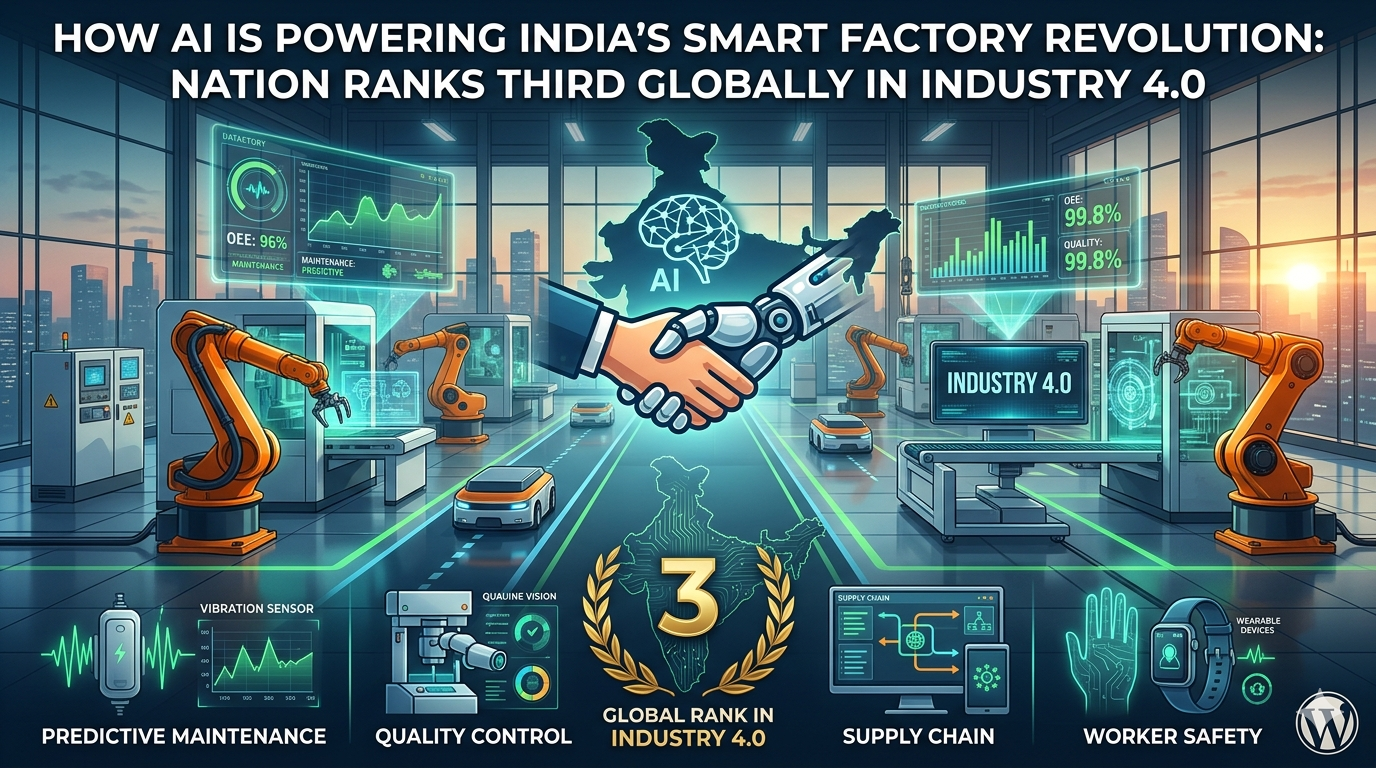
New Delhi, March 24, 2026 — India has claimed third place in global industry digitisation, trailing only the United States and China, according to the Industry 4.0 Barometer 2026 published on March 18 — a ranking that underscores how rapidly Indian manufacturers are embracing artificial intelligence, industrial IoT, and advanced automation on the factory floor.
The Technology
Industry 4.0 refers to the integration of digital technologies — AI, machine learning, IoT sensors, robotics, and cloud computing — into industrial production systems to create smart factories capable of real-time monitoring, predictive maintenance, and autonomous decision-making. The Barometer, which surveyed manufacturers across major economies, found that 61% of Indian companies surveyed are already deploying AI in their production environments. That figure places India ahead of several European manufacturing powers in active AI adoption, reflecting both the falling cost of cloud-based AI deployment and a growing base of digitally literate engineers across Indian industry. The survey also noted that India, Mexico, and the United States are modernising and implementing Industry 4.0 tools faster than companies in the DACH region and the United Kingdom.
India’s Industrial Adoption
The scale of adoption is being driven by a convergence of global technology partnerships and domestic capacity building. NVIDIA, in a high-profile collaboration announced in early 2026, has partnered with global industrial software leaders to deploy AI-driven manufacturing platforms at several of India’s largest manufacturers, spanning automotive, electronics, and process industries. Union Minister for Electronics and IT Ashwini Vaishnaw launched an AI Manufacturing Engineering Technology (MET) White Paper at the India AI Impact Summit 2026, outlining a government-backed roadmap covering AI skills development, adoption incentives, and inclusive industrial growth as key drivers of competitiveness. India’s smart factory market, valued at US$ 7.7 billion in 2025, is projected to reach US$ 17 billion by 2032 at a compound annual growth rate of approximately 12%.
Opportunity & Challenge
The opportunity is substantial: India is investing an estimated US$ 134 billion in new manufacturing capacity across construction, automotive, renewable energy, and robotics — all of which require smart-factory integration to remain globally competitive. The electronics manufacturing sector alone is targeting US$ 300 billion in annual output, a goal achievable only with AI-driven yield optimisation and supply-chain automation. Digital technologies are on track to account for 40% of total manufacturing expenditure, up from 20% in 2021. However, challenges remain significant. The skills gap between demand for AI-literate manufacturing engineers and current supply is acute, particularly outside major industrial hubs such as Pune, Chennai, and Bengaluru. The capital expenditure required for full Industry 4.0 retrofitting also places the transformation out of reach for a large share of India’s MSMEs, which account for a disproportionate share of manufacturing employment.
What’s Next
The government’s AI MET White Paper is expected to catalyse a cluster of pilot programmes in industrial corridors such as the Delhi-Mumbai Industrial Corridor (DMIC) and the Chennai-Bengaluru Industrial Corridor over the next 18 months. Policy support under the PLI scheme is being explored for smart-factory component manufacturing — robots, sensors, and edge computing hardware — to reduce dependence on imports and build a domestic supply chain for the tools of digitisation itself. As India positions itself as a credible global manufacturing alternative, the speed at which it can scale Industry 4.0 adoption beyond its top-tier factories will determine whether its newly earned third-place ranking in industrial digitisation translates into lasting export competitiveness.
— Industrial Front Desk












Leave a comment