

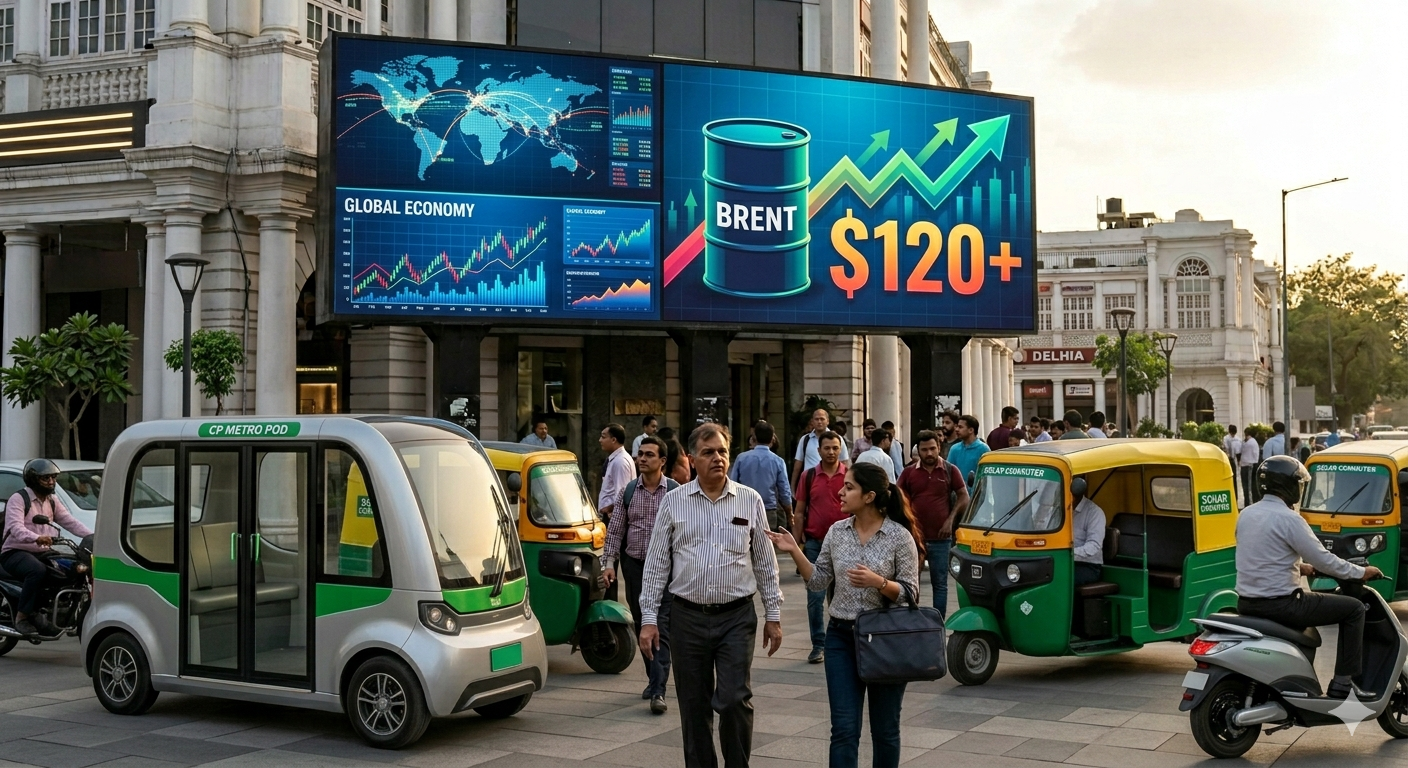
New Delhi, March 25, 2026 — Brent crude oil has breached $100 per barrel this week, driven by an intensifying US-Israel-Iran conflict that has severely disrupted shipping through the Strait of Hormuz and cut global oil flows by up to 10 million barrels per day. Indian oil marketing companies are currently absorbing the price shock, but a sustained period of triple-digit crude will place significant pressure on India’s import bill, petrochemical sector, and manufacturing margins.
The Global Picture
Brent crude has surged to approximately $102.50 per barrel and WTI to around $101.20 per barrel, reflecting a geopolitical risk premium not seen since 2022. The Strait of Hormuz — through which approximately 20% of global oil and LNG supplies transit — has seen flows plunge dramatically as Gulf producers cut output by at least 10 million barrels per day. The International Energy Agency (IEA) responded on March 11, 2026, by releasing 400 million barrels from member-country strategic reserves, but market anxiety remains elevated. The WTO has warned that if elevated crude prices persist through 2026, global merchandise trade growth could fall to just 1.4% — 0.5 percentage points below prior forecasts — while global GDP growth could be trimmed by 0.3 percentage points, according to recent modelling by the World Economic Forum.
India’s Exposure
India imports approximately 85% of its crude oil requirements, making it acutely vulnerable to elevated Brent prices. At $100+ per barrel, India’s annual crude import bill could exceed $180 billion — a significant jump from roughly $150 billion in FY2025 — adding pressure to the current account deficit and the rupee. State-run oil marketing companies Indian Oil Corporation (IOCL), Bharat Petroleum (BPCL), and Hindustan Petroleum (HPCL) are currently holding domestic petrol and diesel prices steady at ₹94.77 per litre and ₹87.67 per litre respectively in Delhi, drawing down marketing margins built up during lower-price periods. Analysts widely expect a retail price revision of ₹5–10 per litre if Brent sustains above $100 for more than four to six weeks, which would add meaningfully to headline CPI inflation.
Sectors Most at Risk or Benefit
• Petrochemicals & Plastics: Rising naphtha and feedstock costs will squeeze margins for manufacturers such as Reliance Industries, GAIL, and ONGC’s downstream units, with downstream polymer prices likely to rise 5–8%.
• Aviation & Logistics: Jet fuel prices will increase, raising operating costs for IndiGo, Air India, and surface freight carriers, with potential pass-through to consumer goods pricing across the supply chain.
• Fertilisers: Higher natural gas and LPG input costs will raise fertiliser production expenses, straining the government’s subsidy outlay ahead of the critical Kharif agricultural season beginning in June.
• Upstream Oil & Gas (Beneficiary): ONGC and Oil India Limited stand to benefit from improved realisations on domestically produced crude, with each $10/barrel increase in Brent adding approximately ₹4,000–5,000 crore to their annual revenues.
Outlook
The trajectory of crude prices through April 2026 will hinge on two key variables: the pace of diplomatic de-escalation in West Asia, and whether IEA reserve releases succeed in supplementing global supply sufficiently to moderate the geopolitical premium. J.P. Morgan’s Global Research team maintains a 2026 average Brent forecast of $60 per barrel, implying the current spike is treated as transitory — but risk skews sharply upward in a scenario of prolonged Hormuz disruption. For India, the RBI’s April 2026 Monetary Policy Committee meeting will be closely watched for any revision to inflation projections linked to elevated energy costs, with the central bank already navigating a delicate balance between growth support and price stability.
— Industrial Front Desk









Leave a comment