

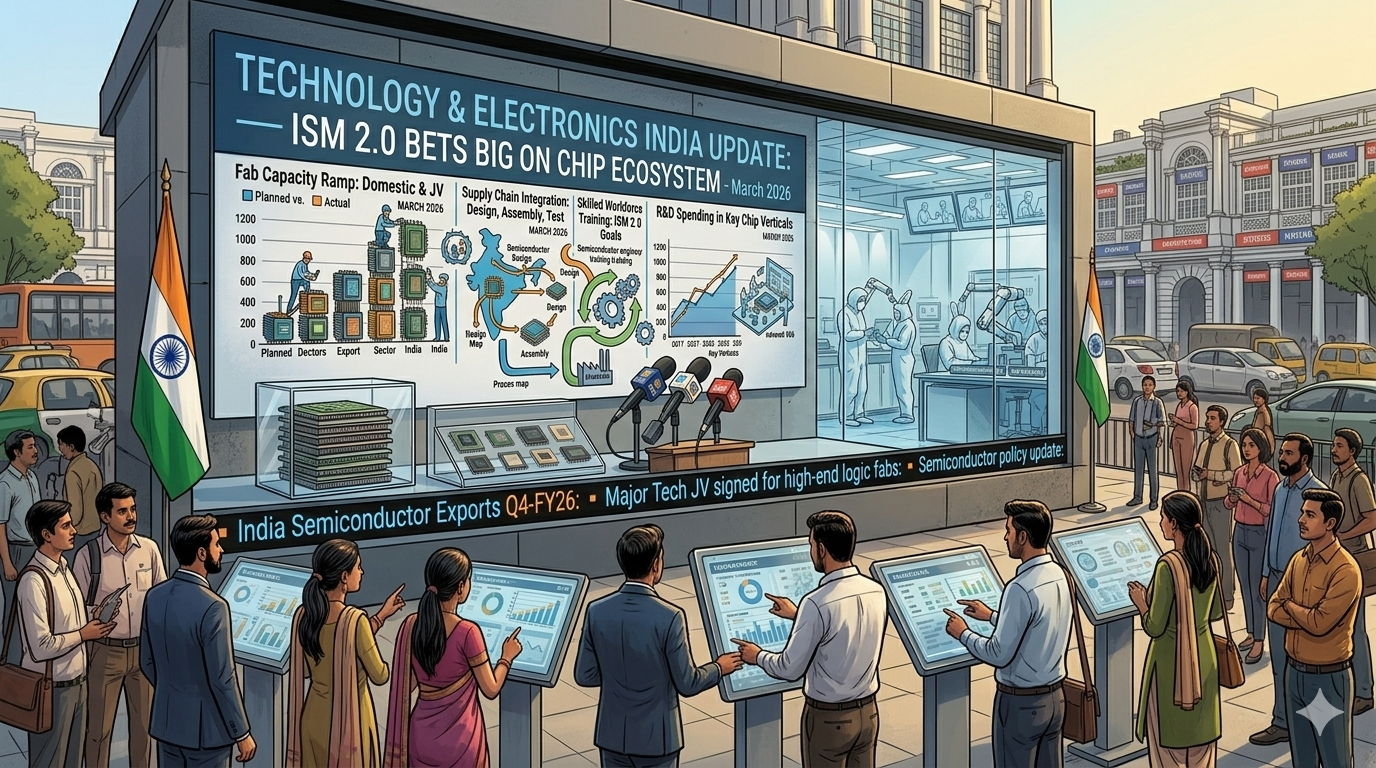
New Delhi, March 25, 2026 — India’s semiconductor and electronics manufacturing push gained decisive momentum in Q1 2026, with the government formally launching India Semiconductor Mission 2.0 (ISM 2.0) in the Union Budget and multiple chip facilities advancing from construction to production stages. With 10 semiconductor units approved and total investment commitments crossing ₹1.6 lakh crore ($17.3 billion), India is positioning itself as a credible alternative to East Asian chip supply chains.
Key Developments
Union Budget 2026–27 announced India Semiconductor Mission 2.0 with an initial ₹1,000 crore provision for FY2026-27, expanding the scope of the original Semicon India Programme beyond assembly toward domestic equipment manufacturing and full-stack Indian semiconductor IP design. India’s first commercially operational semiconductor facility — a Micron-backed ATMP (Assembly, Testing, Marking & Packaging) unit in Sanand, Gujarat — ramped capacity to approximately 0.5 million units per day in early 2026, with the under-construction G2 facility targeting 14.5 million units per day and over 5,000 direct jobs on completion. A total of 10 semiconductor units have now been approved under the Semicon India Programme, comprising two fabrication plants and eight ATMP/OSAT facilities, with three currently in pilot production phases. India’s overall electronics production reached approximately $115 billion in FY2026, up 14% from $101 billion in FY2025, according to MeitY data.
Policy & Government Action
The Ministry of Electronics & Information Technology (MeitY) is driving ISM 2.0 across three pillars: semiconductor equipment and materials manufacturing in India, development of indigenous semiconductor intellectual property, and supply chain resilience through domestic sourcing. MeitY has committed to establishing industry-led research and training centres aligned with ISM 2.0 objectives. Concurrently, the PLI scheme for IT Hardware continues to attract global ODMs and contract electronics manufacturers, supporting domestic production of laptops, tablets, servers, and embedded electronics. DPIIT has also fast-tracked single-window clearances for greenfield electronics manufacturing clusters in Gujarat, Uttar Pradesh, and Tamil Nadu, reinforcing India’s Make in India push across the full electronics value chain.
Companies & Market Activity
Tata Electronics — which holds a joint venture with Taiwan’s PSMC for a greenfield semiconductor fab in Dholera, Gujarat — continues to execute its roadmap, with the Dholera fab targeted for commercial production in FY2027. Kaynes Semicon and CG Power (backed by Japan’s Renesas Electronics) are progressing their ATMP units under the Semicon India Programme. Samsung has been identified in recent trade reporting (Digitimes, March 2026) as actively evaluating India as a key semiconductor supply chain hub, complementing its existing smartphone and display manufacturing operations in Noida. Deloitte’s latest sector report projects India’s semiconductor market will grow from $62 billion in 2026 to $155 billion by 2031, representing a compound annual growth rate of approximately 20%.
What to Watch
• Tata-PSMC Dholera fab construction progress and confirmed commercial production timeline, expected in H2 FY2027.
• Samsung’s formal announcement on whether it will establish an ATMP facility or chip design centre in India, widely anticipated in Q2 2026.
• Government notification of ISM 2.0 detailed guidelines and the application window for semiconductor equipment and materials manufacturers, expected by April–May 2026.
— Industrial Front Desk












Leave a comment