

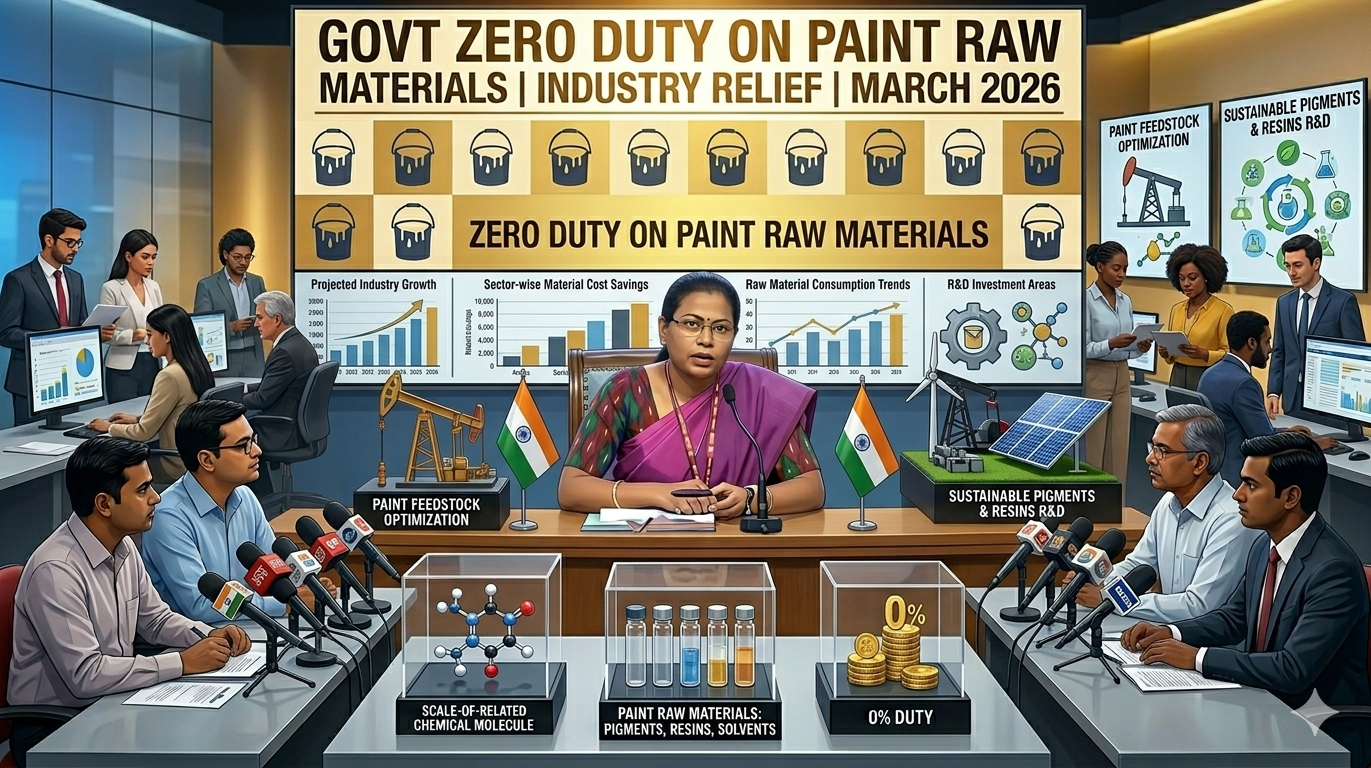
India’s government has moved decisively to shield the paint manufacturing sector from supply shocks triggered by escalating West Asia tensions, unveiling a package of relief measures that includes zero basic customs duty (BCD) on critical polymer inputs and mandatory petrochemical allocations from domestic refineries.
The measures, announced through a Department for Promotion of Industry and Internal Trade (DPIIT) notification dated April 1, 2026, represent a significant intervention to stabilize a sector heavily dependent on imported petrochemical feedstock and energy inputs.
Duty Cut on Key Raw Materials
In the central relief move, the government has eliminated BCD on three critical polymers:
- HDPE (High-Density Polyethylene)
- LLDPE (Linear Low-Density Polyethylene)
- PPCP (Polypropylene Copolymer)
These materials form the backbone of modern paint formulations, particularly in protective coatings and industrial applications. Industry sources indicate the duty waiver alone could reduce input costs by 5–8%, offering immediate relief as raw material shortages have begun inflating production expenses.
Refinery Directives and Butyl Acrylate Push
Beyond tariff relief, the government has mandated IOC refineries at Mathura and Vadodara to supply butyl acrylate equivalent to 0.2 TMT per day of propylene to support domestic paint production. Quality control norms for butyl acrylate have been temporarily relaxed until July 10, 2026, enabling faster domestic availability without regulatory delays.
This directive acknowledges a critical bottleneck: butyl acrylate is essential for high-performance coatings but remains largely imported, with Iran-linked shipping delays creating acute supply shortages.
Industrial LPG Allocation Surge
Paint manufacturers relying on LPG for manufacturing processes will benefit from a substantial increase in industrial LPG allocation—raised from 50% to 70% of pre-March 2026 bulk consumption levels. This revision directly addresses production continuity for smaller and mid-sized paint manufacturers who depend on consistent fuel availability.
Broader Sector Relief
The government’s intervention extends beyond paints:
- Tyres: Zero BCD on polybutadiene and styrene butadiene rubber
- Glass: PNG allocation at 80% of average consumption; LPG boost
- Ceramics (Morbi): Fresh PNG supply notification; pricing stabilization
Energy Supply Status
Officials confirmed India’s energy infrastructure remains stable despite global volatility:
- All major refineries operating at full capacity with adequate crude inventories
- Petrol and diesel supplies uninterrupted; excise duty reduced by Rs 10/litre
- Domestic LPG prioritized; 94% of deliveries authenticated via DAC to prevent diversion
- Commercial LPG supply improving—1,31,879 MT supplied in April alone
Supply Chain Enforcement
Authorities have launched an aggressive crackdown on hoarding and black marketing:
- 3,200+ raids conducted nationwide
- 2,000+ LPG cylinders recovered
- 290 LPG distributors penalized; 68 distributorships suspended
Impact on Indian Industry
Manufacturing Competitiveness: Zero duty on polymer inputs levels the playing field for Indian paint manufacturers competing against imports, particularly in decorative and industrial protective coatings segments. Mid-sized players operating at 60–70% capacity utilization due to raw material shortages are expected to ramp up output.
Cost Pass-Through Risk: While duty elimination reduces input costs, global crude and petrochemical volatility may still pressure margins. Paint manufacturers with fixed-price contracts signed pre-April 1 face compression until Q2 cost reviews take effect.
Supply Resilience: The government’s direct mandate to IOC refineries for butyl acrylate output signals a shift toward supply-side interventions rather than relying on imports. This establishes a precedent for petrochemical self-sufficiency in non-core segments.
Regional Exposure: The paint sector remains exposed to Strait of Hormuz disruptions for crude supplies. The Indian-flagged tanker Desh Garima’s safe passage on April 18 is a positive signal, but sustained geopolitical tensions could reintroduce volatility.
Timeline: These measures are designed as temporary relief (quality norm waiver ends July 10). Manufacturers should plan capacity expansion and supply chain diversification accordingly to lock in gains before normalcy returns.
What This Means
For paint industry stakeholders, the zero-duty push on polymers and refinery-backed petrochemical allocations address two core pain points—raw material access and cost. However, the measures’ temporary nature suggests the government views West Asia tensions as transient. Paint companies should use this window to negotiate long-term refinery contracts, invest in capacity, and accelerate supply chain diversification.
Source: Reporting based on government inter-ministerial briefing held April 23, 2026, as reported by Zee Business (April 24, 2026).









Leave a comment