


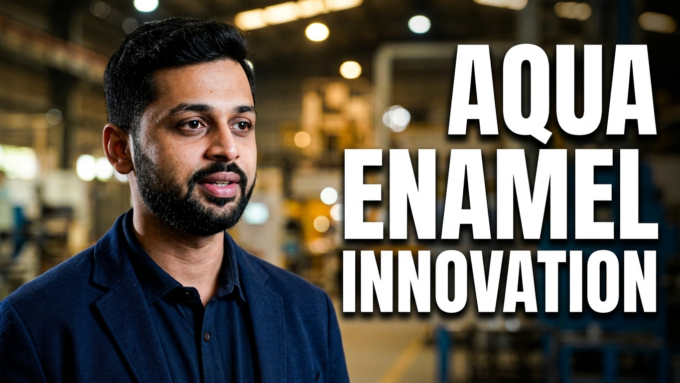
Insights from Mr. Satish Jan, Technical Service and Business Development Manager at allnex, presented at the Paintvision Global Business Summit 2026.
In 2026, the paint and coatings industry stands at a genuine crossroads. Regulators are pushing hard for a transition to waterborne, high-solid, and bio-based formulations to meet global sustainability targets – but end-users in the automotive, protective, and wood sectors simply can’t accept a performance trade-off. If an eco-friendly coating fails to protect a steel structure from corrosion, or slows down an automotive assembly line, it isn’t a viable option, however green its credentials.
At the Paintvision Global Business Summit 2026, Mr. Satish Jan laid out how next-generation resin chemistry is closing that gap. With a footprint spanning 34 manufacturing centres and 23 R&D facilities worldwide – including an active R&D hub in Vikhroli, Mumbai – allnex is developing technologies built on the premise that sustainability and high performance don’t have to be a trade-off.
The ECOWISE Blueprint: Defining True Sustainability
Plenty of manufacturers attach a “green” label to a product without much rigour behind it. allnex instead runs every candidate resin through a five-gate filtration system it calls ECOWISE:
- Gate 1 – Strict chemical limits: the resin must contain less than 0.1% of highly restricted substances such as formaldehyde, styrene, or bisphenol.
- Gate 2 – Solvent thresholds: the product must contain less than 1.0% of hazardous solvents like naphtha or ethylbenzene.
- Gate 3 – Market benchmarking: performance is measured directly against existing market products across five sustainability pillars – emission reduction, safer materials, circular economy, renewable resources, and energy efficiency.
- Gate 4 – The competitive edge: the resin must outperform the market standard in at least one of those five pillars.
- Gate 5 – Full compliance: the product meets all regulatory and market demands while still delivering premium performance.
Only resins that clear all five gates earn the sustainable designation – which is exactly what makes the technologies below worth paying attention to.
1. Automotive Coatings: Direct Adhesion and Sag Control
Automotive formulations rely on complex, multi-layered systems where adhesion and appearance are non-negotiable. Plastic components like polypropylene bumpers have long struggled with direct paint adhesion, so allnex developed Setal XCS 1518 BA 45, a resin grafted with chlorinated polyolefin (CPO) that enables direct-to-plastic application without a separate adhesion promoter.
In metallic base coats, where pigment alignment determines the final metallic effect, sag control matters just as much. Setal 90173 incorporates a sag control agent (SCA) that prevents heavy aluminium or mica flakes from settling unevenly, keeping metallic orientation uniform across vertical surfaces.
2. Heavy-Duty Protective Systems: Bridging the 1K and 2K Gap
Protective coatings for railways, agriculture, construction equipment (ACE), and military applications need to withstand aggressive environmental exposure – and waterborne systems have historically struggled to match solvent-borne performance in this segment.
The “Easy Cure” 2K epoxy system: For ultra-high performance, allnex’s 2K Easy Cure waterborne system pairs Beckocure 2260 as the hardener with either Beckopox 2384 (for high hardness) or Beckopox 387 (for flexibility). This combination delivers 1,000+ hours of salt spray resistance and excellent tolerance to sub-optimal surface preparation, allowing application over light oil residues without film defects.
Bridging the gap with 1K Beckopox 2120: Traditionally, one-component (1K) waterborne systems max out around 240 hours of salt spray resistance, pushing manufacturers toward more complex 2K systems for harsher environments. Beckopox 2120 was built to close that gap – a 1K cationic epoxy ester system that applies as easily as a standard 1K product but achieves over 800 hours of salt spray resistance, making it well suited to automotive chassis and ACE primers.
Critical Precautions When Formulating with Waterborne Resins
Waterborne emulsions are sensitive to processing conditions. Mr. Jan highlighted a few rules of thumb worth posting on the shop floor:
- Temperature control: never store waterborne resins below freezing or above 40°C – extreme temperatures disrupt emulsion stability.
- Shear limits: during pigment dispersion and high-speed stirring, keep the batch temperature under 40°C. High shear heat can break the emulsion.
- Filtration: waterborne resins can form a surface “skin” during long storage – always filter before introducing the resin into your system.
- Additive balance: choose defoamers and wetting agents carefully to avoid cratering and ensure proper film formation.
3. Fast-Cure Technology: Cutting Refinish Times from Days to Hours
In the car refinish and repair industry, vehicle turnaround is the primary bottleneck. Traditional solvent-borne repair clear coats can take two to three days to fully cure and reach polishable hardness. allnex’s Fast Cure acrylic and polyester resins cure at lower temperatures with an exceptional pot-life-to-drying ratio – letting refinish shops safely polish a repaired car just one hour after painting, a dramatic cut in both energy consumption and garage downtime.
4. Premium Wood Coatings: Solving the Aesthetic and Tannin Bleed Dilemma

Waterborne wood coatings have long carried two common complaints: a hazy, “milky” appearance over dark woods, and colour fading caused by tannin migration.
Water-white clarity – the Setaqua series: Standard water-based acrylics tend to look turbid or milky straight from the can. allnex’s Setaqua series takes a surfactant-free approach with an unusually small particle size of around 90 nanometres, giving the liquid resin a highly translucent appearance. The result is the rich “wet look” and depth of clarity typically associated with solvent-borne systems.
NC sealer speed – Setal 164-106: Nitrocellulose (NC) sealers are prized for their fast dry times. Setal 164-106 serves as a direct, eco-friendly replacement, drying so quickly that operators can sand the wood film after just 25 to 30 minutes – reproducing the same dry “powdering” effect as traditional NC sealers.
Blocking tannins in mango wood: Exotic woods like mango wood contain water-soluble tannins that bleed into waterborne topcoats, causing yellowing and unsightly staining. allnex addresses this with anti-tannin primers formulated using Duroxy 2406 or Resydrol SF 8002, which lock tannins deep within the wood grain before they can migrate.
The patented 3-layer hybrid – Resydrol SF 8002: Perhaps the most versatile product in the wood range, Resydrol SF 8002 is a patented three-layer alkyd-acrylic hybrid (50% solids, MFFT 21°C) that combines the deep substrate penetration of an alkyd with the fast drying and exterior durability of an acrylic. It achieves a high gloss of 84 to 86 units and is robust enough to serve as a multi-substrate enamel, replacing solvent-borne coatings across wood, metal, and concrete alike.
By deploying targeted macromolecular designs – whether through alkyd-acrylic hybridisation, CPO grafting, or sub-100nm emulsion control – paint manufacturers can confidently transition to sustainable formulations while still delivering the performance their customers demand.











Leave a comment