

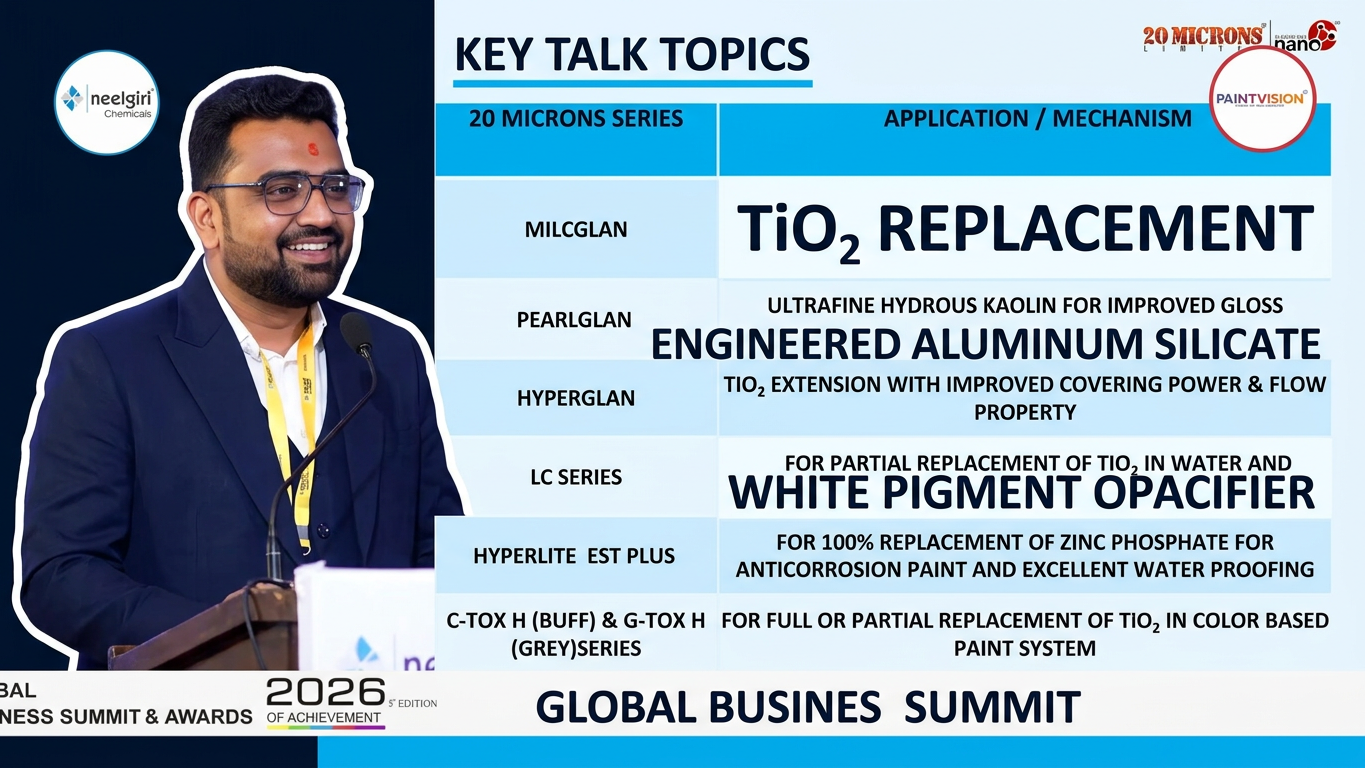
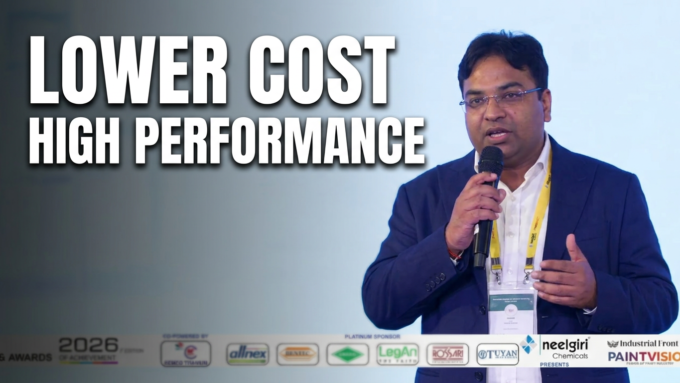
Insights from Dr. Hemant Patel, presented at the Paintvision Global Business Summit 2026.
As titanium dioxide prices remain volatile and input cost pressure mounts across the paint industry, 20 Microns Limited is pioneering a shift away from treating minerals as inert “fillers” and toward engineering them as precision performance additives. Dr. Hemant Patel’s presentation at PaintVision 2026 was among the most technically dense of the summit, drawing on the capabilities of the company’s DSIR-recognised R&D centre – including advanced tools like zeta potential analysis – to manipulate pigment Brownian motion for superior hiding and formulation stability.
TiO2 Replacement: The LC Series
The crown jewel of 20 Microns’ innovation portfolio is LC 1465, a product that lets formulators replace up to 25% of pure TiO2 in their recipes without any visible compromise in hiding power or whiteness. The technology works by chemically co-precipitating titanium dioxide onto calcium carbonate particles using rotor-stator mixing techniques, creating a hybrid pigment-extender where TiO2 is uniformly surface-distributed rather than present as discrete particles.
The economic impact is immediate and measurable: a cost saving of ₹4.26 to ₹7.82 per litre of finished paint, depending on formulation, with no change required to dispersion or grinding processes. It’s compatible with both interior and exterior emulsion formulations, and maintains VOC targets and application rheology throughout.
Magnetic Purification: The Pulgen Innovation
At the company’s Bhuj processing facility, 20 Microns operates a 5-tesla cryogenic magnet running at −260°C – technology borrowed from the medical and semiconductor industries – to remove paramagnetic iron impurities from raw kaolin ore. The resulting product, Pulgen, is an ultra-fine hydra-kaolin with a measurably lower yellowness index compared to conventionally processed alternatives.
The practical implication for formulators is significant: because Pulgen’s whiteness baseline is higher, it can be used at greater dosage levels in premium interior emulsions without the formula drifting yellow – opening a cost-efficient path to premium white and tinted products that previously needed higher TiO2 loadings to maintain whiteness standards.
Anti-Corrosive Performance: Hyperllight
Hyperllight is 20 Microns’ engineered kaolin for anti-corrosive paint applications, distinguished by its high aspect ratio hexagonal platelet structure. When dispersed in a paint film, these platelets align parallel to the substrate surface, creating a physical barrier that significantly extends the moisture and oxygen diffusion path. In testing, it delivers 900 hours of salt spray performance without failure (ASTM B117), offers 100% substitution capability against zinc phosphate, and does so at roughly a 20% cost saving versus zinc phosphate – making it well suited to industrial, marine, and infrastructure anti-corrosive coatings.
Inorganic Co-Thickeners: Hydroxygel
Hydroxygel answers one of the most pressing cost pressures in waterborne formulation: the rising price of organic thickeners. HPMC (hydroxypropyl methylcellulose) and MHSC variants have climbed sharply in cost, driven by cellulose feedstock constraints and import dependence. Hydroxygel, an engineered bentonite-based inorganic co-thickener, can replace 50% of these organic thickeners without affecting formulation performance. It works by controlling the inter-platelet spacing within the bentonite particle, creating an opaque jelly structure with a viscosity of around 7 lakh centipoise – at that range, it provides strong pigment suspension, prevents phase separation in textured and rustic formulations, and improves stability during storage and transport.
The Milkland Series: Engineering the Finish
The Milkland range demonstrates perhaps the most remarkable dimension of 20 Microns’ surface engineering capability: the ability to determine the gloss level of the final paint film through mineral particle design alone. By controlling particle size distribution, surface treatment, and packing geometry, the Milkland series offers formulators a spectrum from high-gloss finishes to dead-matte effects – without changing the binder, pigment volume concentration, or application method. That gives paint manufacturers a formulation lever previously achievable only through expensive matting agents or binder selection changes.
Taken together, these innovations point to a broader shift in how the industry thinks about minerals – not as passive bulk fillers, but as precisely engineered components that can replace expensive pigments, cut cost, and unlock performance that was previously the exclusive domain of specialty chemistry.








Leave a comment