

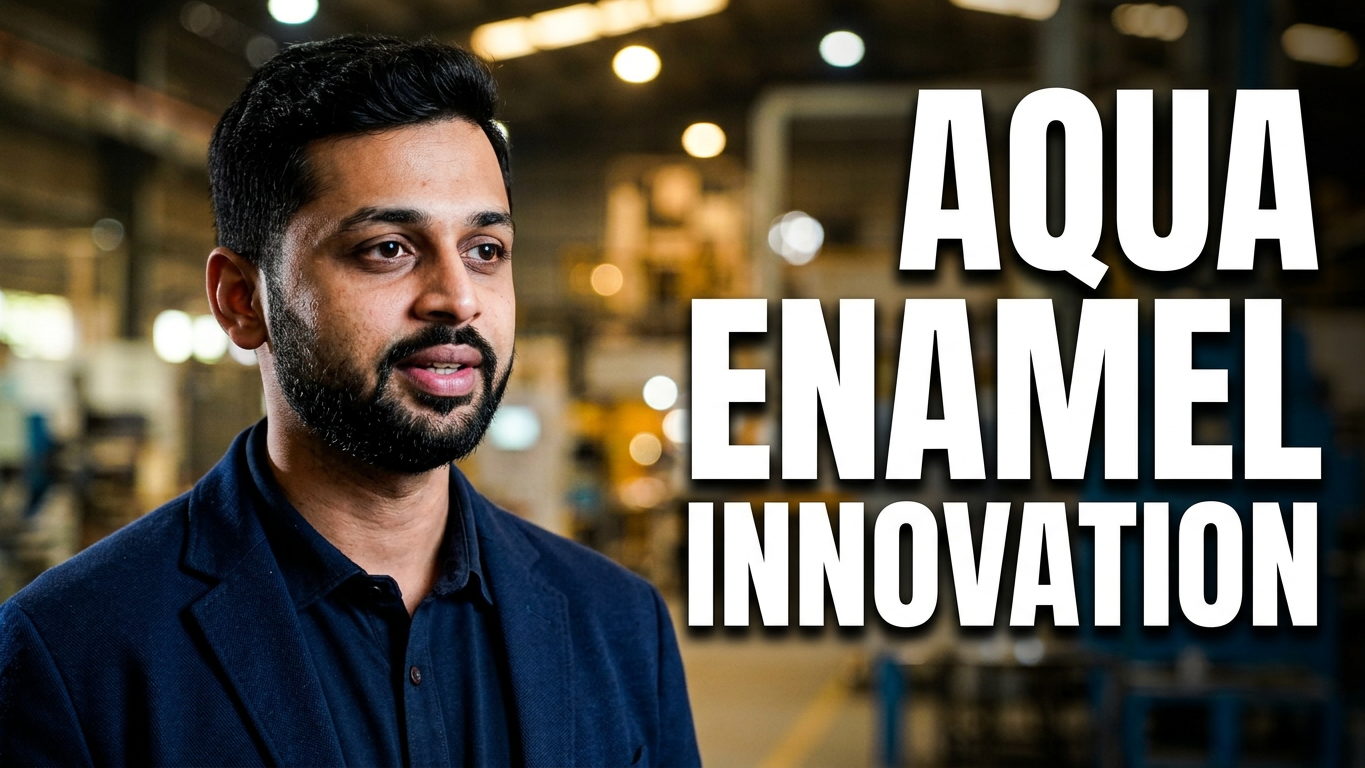
The Ultimate Paint Paradox: A History of Chemical Conflict
For decades, the coatings industry has been defined by a fundamental chemical divide: the battle between solvent-based and water-based systems. This tension isn’t merely academic – it dictates the cost structure, environmental footprint, and performance profile of every litre produced. While solvent-based alkyd paints remain the benchmark for durability and gloss, they rely heavily on expensive Mineral Turpentine Oil (MTO) and volatile organic solvents that modern manufacturers are under intense pressure to reduce.
Historically, bridging this gap was considered a chemical impossibility. In polymer chemistry, oil and water are natural enemies, and early attempts to introduce water into solvent-based synthetic enamels without sophisticated intermediary chemistry resulted in catastrophic failures – immediate gelling, uncontrollable foaming, resin separation, storage instability. Even when a mix looked stable in the can, application often suffered from blistering under heat or severe pigment settling. For years, the industry simply accepted that adding water meant watering down the quality. A breakthrough in proprietary additive technology has now turned that chemical conflict into a high-performance partnership.
Introducing Bentech HULV 100: The “Egg Yolk” of Industrial Coatings
The easiest way to understand the underlying chemistry is the “mayonnaise metaphor.” In the kitchen, oil and water only unite through an egg yolk, which acts as a stable emulsifier. In the industrial lab, Bentech HULV 100 serves as that proprietary “egg yolk,” binding oil (enamel or primer) and water into a perfectly stable matrix. The name pays homage to its developers, Mukund Hulyalkar and V.V. Joshi – “HUL” stands for Hulyalkar, not the multinational consumer goods company.
HULV 100 isn’t a simple post-addition emulsifier; it’s introduced during the grinding stage, where it’s engineered to control “free water” within MTO-based systems, locking water into the polymer matrix rather than letting it remain as a separate, corrosive element. Even at remarkably low dosages of 0.2% to 0.5%, it achieves what was once thought impossible: where traditional systems could tolerate water addition of only 0% to 10% by volume before separating or gelling, the HULV 100 range handles 30% up to a full 1:1 ratio with long-term storage stability, while also replacing up to 50% of MTO – a level of solvent substitution that was previously negligible.
Smashing the Performance Trade-off: High Gloss and Zero Defect Engineering
The greatest barrier to adopting water-reducible enamels has always been the fear of quality degradation. HULV 100 doesn’t merely tolerate water – it puts it to work. As the water evaporates from the applied film, the shift in refractive index actually improves the coating’s opacity, meaning HULV 100-modified paints can often provide better hiding power than their purely solvent-based counterparts.
The performance benchmarks bear this out: gloss retention stays high at 88–90%, even at a 1:1 water addition ratio, and the chemistry successfully handles notoriously difficult pigments like chrome yellow, phthalo blue, and black, which traditionally suffer from flotation, separation, or pinholing when water is present. Formulations maintain a stable viscosity of 78 KU (Krebs Units) and a specific gravity of roughly 0.972, so the paint doesn’t thicken or thin over time. The technology also improves lubricity and brushability – painters have long known that a splash of water makes a brush “move better,” and HULV 100 makes that instinct scientifically sound while preserving excellent sag resistance. Drying stays on a standard enamel timeline, with surface dry in 90–150 minutes and hard dry in 8 hours, and the finish is engineered to be entirely blister-free, even under direct sunlight and high heat.
The Economic and Green Win-Win: Reclaiming Margins and Reducing Emissions
In a landscape where “green chemistry” is often associated with higher costs, Bentech offers a rare alignment of environmental responsibility and profitability. Until now, the industry’s main alternative was “water reducible alkyds,” which often cost upwards of ₹400/kg – commercially unviable for many segments. HULV 100 allows manufacturers to keep using standard resins while substituting expensive MTO with water. By reducing MTO content from 50% to 25%, manufacturers drastically lower VOC emissions and move toward green certification without the premium price tag of specialty resins – replacing a volatile, petroleum-linked cost with a nearly free alternative, and reclaiming significant margins while delivering a high-gloss, sustainable product.
Mindset Over Matter: The Final Frontier of Sustainable Chemistry
The technical and economic case for HULV 100 is proven, but the final hurdle is what might be called the “expiry date of knowledge” – the old assumption that a pungent solvent smell is the only real indicator of quality. The remaining challenge for modern manufacturers is overcoming the mindset blocks of factory-floor chemists and old-school painters still tethered to solvent-heavy tradition. What was once dismissed as a “crazy idea” is now a proven tool for survival in a low-VOC, high-cost world.
Bentech’s Aqua Enamel innovation is more than an additive – it’s a catalyst for the next era of coatings, built on the promise that a formulation can be scientifically superior, significantly greener, and substantially more profitable, all at once.








Leave a comment