

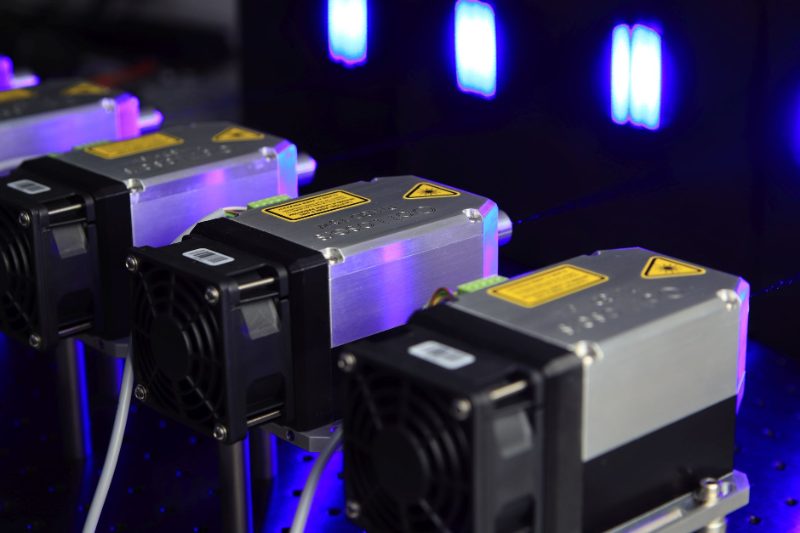
India has demonstrated its first 5.56 km free-space quantum key distribution (QKD) link, a step toward quantum-secure communication that does not depend on fibre cables. The field trials ran on September 27-28, 2026, and were reported by the Ministry of Electronics and IT (MeitY) on October 3, 2026.
The link was built by Bengaluru-based QNu Labs together with the Bhaskaracharya National Institute for Space Applications and Geo-informatics (BISAG-N) and IIT Gandhinagar. According to the reported details, the system kept its quantum bit error rate (QBER) below 5% and generated secure encryption keys at 230 to 260 bits per second.
What Is a Free-Space Quantum Key Distribution Link?
Quantum key distribution uses the properties of light particles to share encryption keys between two points, so that any attempt to intercept the keys disturbs the signal and can be detected. Most Indian QKD demonstrations so far have used optical fibre. A free-space link sends the quantum signal through open air between two sites, here a 5.56 km path between BISAG-N and IIT Gandhinagar in Gujarat.
This matters because fibre cannot reach every location, and satellite-based quantum communication will need ground stations that can aim and hold a link through the atmosphere. The trial is described as bridging fibre-based QKD networks and future ground-to-satellite quantum links.
How Was the Quantum-Secure Link Built?
The setup combined QNu Labs’ Pointing, Acquisition and Tracking (PAT) system, which keeps the transmitter and receiver aligned over distance, with its Armos QKD device. It was paired with BISAG-N’s Vedic Kavach platform, which uses post-quantum cryptography. Together, the quantum key exchange and the post-quantum layer give a two-layer approach to protecting data.
What Does This Mean for Indian Businesses and Government?
Quantum-secure links are most relevant for defence, government networks, banking and critical infrastructure, where data stolen today could be decrypted by future quantum computers. A working free-space demonstration shows that Indian-built hardware can handle the alignment and key-generation steps domestically. Commercial deployment timelines were not given in the material reviewed, so enterprises should treat this as a technology milestone rather than a product launch.
Industry Reaction and Policy Backing
No separate analyst or industry-body commentary was found at the time of writing. The work sits within India’s National Quantum Mission, approved in April 2023 with a budget of ₹6,003.65 crore, which targets satellite-based quantum communications across 2,000 km by 2030-31.
What Happens Next?
The next milestones to watch are longer free-space distances, higher key rates, and tests that connect ground links with satellite-based systems under the National Quantum Mission. Any announcements on pilots with government or enterprise users would signal movement toward deployment.
Frequently Asked Questions
What did India demonstrate in the quantum key distribution trial?
India demonstrated its first 5.56 km free-space QKD link between BISAG-N and IIT Gandhinagar, built by QNu Labs with BISAG-N and IIT Gandhinagar, with MeitY involvement. Field tests took place on September 27-28, 2026.
How fast were the quantum keys generated?
The system produced secure keys at 230 to 260 bits per second while keeping the quantum bit error rate below 5%.
Why is free-space QKD important?
Free-space links do not need laid fibre and are a building block for ground-to-satellite quantum communication, which India’s National Quantum Mission targets over 2,000 km by 2030-31.











Leave a comment