

The article provides a comprehensive technical overview of rubber-based resins specifically tailored for the coatings and paint industry. The presentation highlights the chemical evolution of these polymers, focusing on the production and specialized benefits of chlorinated rubber, which serves as a versatile binder known for its superior water resistance and rapid drying times. Pradhan details diverse industrial applications ranging from marine and swimming pool coatings to high-durability road marking paints and specialized security inks for currency.
1. Introduction to Rubber-Based Resin Chemistry
Rubber-based resins, particularly chlorinated rubber (CR), represent a specialized class of polymers essential for high-performance industrial coatings. Chemically, these are non-active polymers derived from the monomer isoprene. Unlike raw natural rubber, which is unsuitable for direct paint formulation, CR is synthesized through a controlled chemical modification process that transforms the elastomer into a versatile coating material.
2. Synthesis and Physical Properties
The production of chlorinated rubber involves two primary stages:
- Degradation: Natural rubber is first degraded to achieve a specific, consistent molecular weight.
- Chlorination: This degraded rubber is then reacted with chlorine gas.
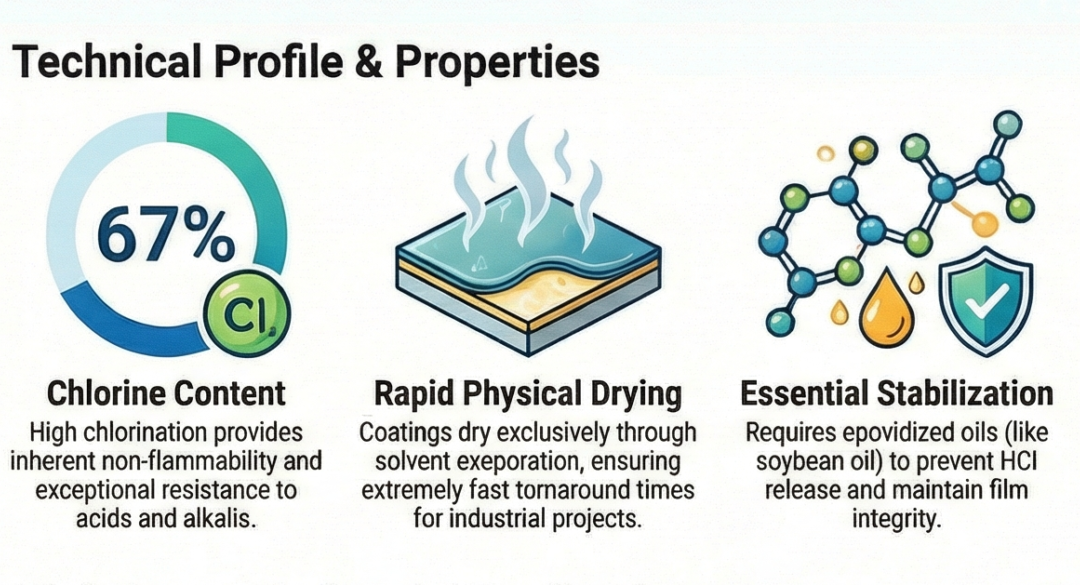
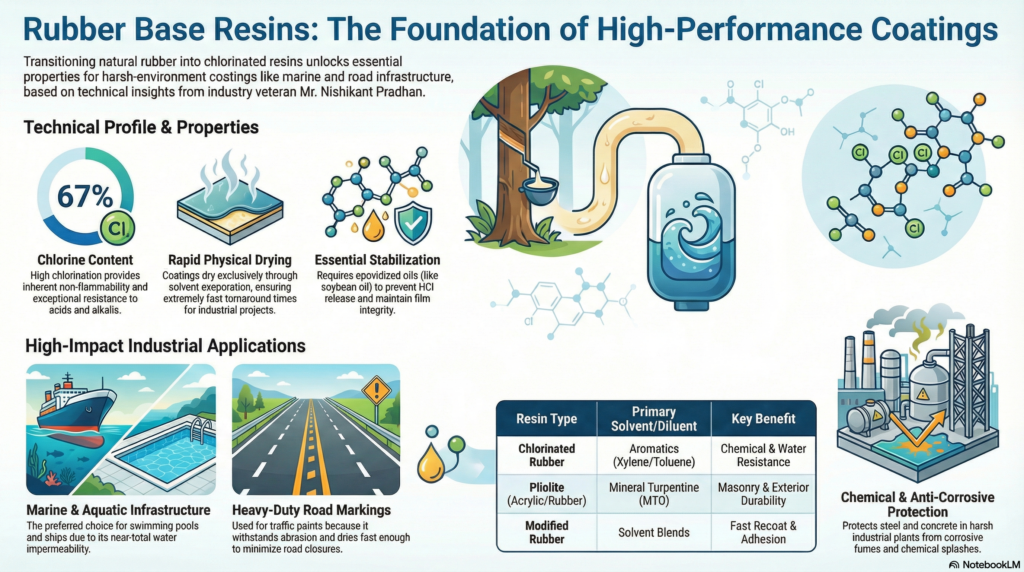
The resulting product is a non-toxic, non-flammable white powder. A critical technical specification of high-quality CR is its chlorine content, which typically ranges from 60% to 67%. While the resin is insoluble in water, it exhibits high solubility in aromatic solvents such as xylene and toluene. For industrial applications, it is commonly prepared in solutions with a concentration of 20% to 25%.
3. Formulation Principles: Addressing Brittleness through Plasticization
A fundamental characteristic of pure chlorinated rubber is its inherent brittleness. To create a durable, non-cracking film, the resin must be formulated with compatible plasticizers. These additives impart necessary flexibility and modify the physical properties of the coating to suit specific industrial requirements.
Key plasticizers utilized in CR formulations include:
- Chlorinated Paraffin Oil (commonly known by the trade name Cereclor).
- Epoxidized Soybean Oil.
- Phthalate Plasticizers, such as DOP (Dioctyl Phthalate) and DBP (Dibutyl Phthalate).
Furthermore, CR resins demonstrate excellent compatibility with other resin systems, such as alkyds, allowing for hybrid formulations that balance drying speed with cost-efficiency and chemical resistance.
4. High-Performance Industrial Applications
The technical advantages of CR—specifically its rapid drying time and resistance to harsh environments—make it the preferred choice for several demanding sectors:
- Marine and Aquatic Coatings: Due to its exceptional water resistance, CR is a standard for ship hulls and swimming pools, where coatings must withstand prolonged immersion and exposure to treated water.
- Road Marking Paints: The fast-drying nature of rubber-based coatings is critical for traffic management, ensuring that road markings can be applied and returned to service with minimal downtime.
- Anti-Corrosive Industrial Maintenance: Its chemical resistance makes it ideal for protecting infrastructure in chemical plants and high-temperature environments, such as industrial containers.
5. Specialized and Niche Market Applications
Beyond traditional paints, chlorinated rubber technology is employed in highly specialized fields:
- Security and Currency Printing: CR resins are used in the formulation of inks for currency notes, providing the durability and chemical stability required for legal tender.
- High-Speed Packaging Printing: The rapid evaporation of solvents from CR films allows for high-speed printing on packets and packaging, where immediate drying is essential for production efficiency.
- Adhesives and Release Coatings: It is utilized as a back-coating for stickers and tapes to prevent unwanted adhesion when rolled, and even in the manufacture of matches to provide specific burning and bonding properties.
6. Conclusion
Chlorinated rubber remains a cornerstone of the technical coatings industry. Its unique ability to combine flame retardancy, chemical inertness, and rapid film formation—when properly plasticized—ensures its continued relevance in protecting critical infrastructure and enabling specialized printing technologies.










Leave a comment