

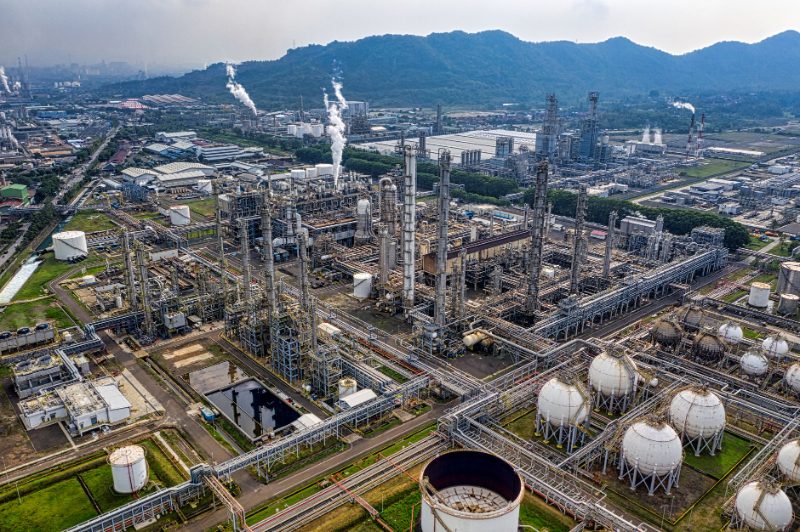
Reliance Industries and the Adani Group are building a combined 3.5 million tonnes per annum of new PVC capacity in India, a PVC capacity expansion India 2026 push aimed at closing the country’s roughly 2.5 million tonne local supply gap in polyvinyl chloride by 2027. Reliance’s 1.5 MTPA PVC complex and Adani’s 2 MTPA build-out mark the two largest domestic investments in India’s plastics raw-material chain in years.
The expansions come as India’s plastics industry, valued at $47.04 billion in 2026 and projected to grow at a 6.24% compound annual rate to $63.69 billion by 2031, continues to rely heavily on imported PVC to meet demand from packaging, construction, pipes and consumer goods manufacturers. Closing the supply gap domestically is seen as central to reducing import dependence and stabilising raw material costs for thousands of downstream plastics processors.
Why Are Reliance and Adani Investing in PVC Capacity Now?
Reliance and Adani are moving on PVC capacity because India currently imports a significant share of its polyvinyl chloride requirements, exposing domestic converters to currency fluctuations and global supply shocks. With Production-Linked Incentive schemes and large infrastructure programs like housing and water-pipeline projects driving structural demand for PVC pipes and fittings, both conglomerates see an opportunity to backward-integrate into petrochemicals. Reliance’s 1.5 MTPA complex leverages its existing refining and cracker infrastructure, while Adani’s 2 MTPA project represents a fresh entry into large-scale petrochemicals, diversifying the group’s portfolio beyond ports, power and cement.
What Does This Mean for India’s Plastics Industry?
For the thousands of small and mid-sized plastics processors that convert PVC resin into pipes, cables, films and consumer products, new domestic capacity should eventually mean more stable and potentially lower input costs once the plants ramp up. Industry estimates suggest the combined 3.5 MTPA addition could narrow India’s 2.5 million tonne supply gap substantially by 2027, reducing reliance on imports from the Middle East and Northeast Asia. However, analysts caution that global PVC prices remain volatile, and Indian producers will still need to compete with lower-cost imports unless supported by tariff protection or logistics advantages.
Market Reaction and Industry Response
Plastics industry associations have broadly welcomed the Reliance and Adani investments, framing them as evidence of confidence in India’s long-term consumption growth across packaging, construction and mobility. Existing PVC producers, including Chemplast Sanmar and DCW, are watching closely to see how the new capacity affects pricing dynamics once Reliance’s and Adani’s plants come online, given that a sudden supply increase could pressure margins across the industry even as it benefits downstream converters. Some analysts have flagged that global overcapacity in petrochemicals, a theme also affecting the broader chemical sector, could complicate the economics of these large new investments if international PVC prices stay weak.
What Happens Next?
Both projects are expected to be phased in over the next one to two years, with industry watchers tracking construction milestones and commissioning timelines closely. The success of this PVC capacity expansion India 2026 initiative will likely be judged by how much it reduces India’s import bill for polyvinyl chloride and whether downstream converters see tangible price stability once the new supply hits the market. India Chem 2026, the government’s flagship petrochemicals exhibition in Mumbai this October, is expected to feature detailed updates from both Reliance and Adani on project timelines and capacity ramp-up plans. Analysts also expect the Department of Chemicals and Petrochemicals to monitor these projects closely as part of its broader push to grow India’s chemicals and petrochemicals sector toward $400-450 billion by 2030, with domestic PVC self-sufficiency viewed as one measurable milestone along that path.
Frequently Asked Questions
How much new PVC capacity are Reliance and Adani adding in India?
Reliance is building a 1.5 MTPA PVC complex while Adani is developing a 2 MTPA PVC facility, together adding 3.5 million tonnes per annum of new capacity as part of this PVC capacity expansion India 2026 push.
Why does India need more domestic PVC production?
India currently faces a supply gap of roughly 2.5 million tonnes of PVC, forcing reliance on imports; new domestic capacity from Reliance and Adani aims to close this gap by 2027 and reduce import dependence.
How will this affect India’s plastics processors?
Downstream plastics processors that manufacture pipes, cables and consumer goods could benefit from more stable domestic PVC supply and potentially lower input costs once the new Reliance and Adani plants are fully operational.









Leave a comment