

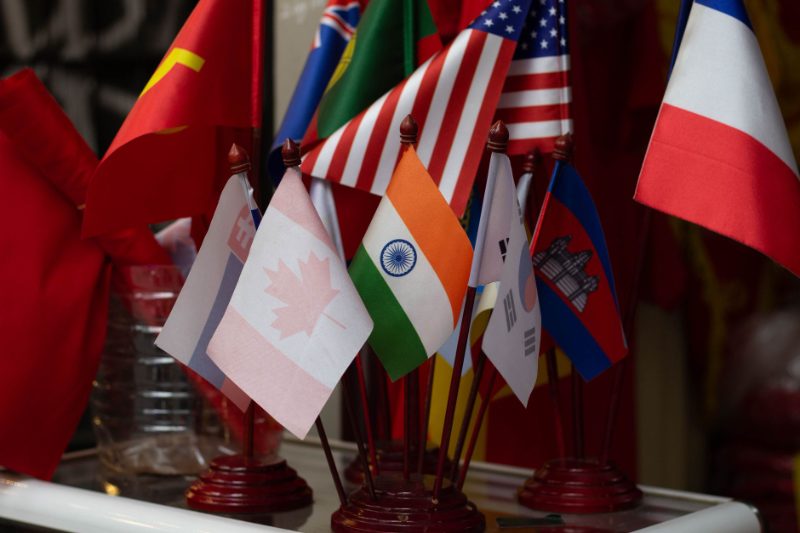
India’s BRICS chairmanship 2026 places the country at the centre of global emerging market diplomacy, with the 18th BRICS Leaders’ Summit scheduled for New Delhi on September 12–13, 2026. India assumed the BRICS chairmanship on January 1, 2026, with the theme “Building for Resilience, Innovation, Cooperation and Sustainability.” Russian President Vladimir Putin has confirmed attendance, making it one of the most geopolitically significant multilateral gatherings on Indian soil in years. India’s BRICS chairmanship 2026 agenda centres on four strategic pillars: CBDC interoperability, AI governance, climate finance reform, and development banking expansion.
This is India’s fourth BRICS chairmanship — previously in 2012, 2016, and 2021. India succeeds Brazil, which hosted the 17th BRICS Summit in 2025. The expanded BRICS now includes 11 full member states and 10 partner countries, representing approximately 40% of global GDP and 45% of the world’s population, making the New Delhi summit a major platform for shaping the post-2025 multilateral order.
What Are India’s Key Priorities for the BRICS 2026 Summit?
India’s BRICS chairmanship 2026 agenda is organised around four strategic pillars. First, CBDC interoperability: India is pushing for a framework to enable cross-border payments between BRICS central bank digital currencies (CBDCs), reducing dependence on SWIFT and the US dollar for intra-BRICS trade settlements. India’s digital rupee has been operational since 2023, and the RBI is coordinating with the People’s Bank of China, South Africa’s SARB, and the Central Bank of Brazil on interoperability standards. Second, AI governance: India is proposing a BRICS AI Framework setting shared norms on data localisation, algorithmic accountability, and AI for development — building on India’s G20 AI presidency contributions. Third, climate finance: India is advocating for New Development Bank (NDB) reform to scale up concessional climate finance, targeting a $50 billion annual lending capacity by 2030. Fourth, development banking reform: India wants the NDB to expand membership and enhance its credit rating to access cheaper global capital.
How Does India’s BRICS Chairmanship 2026 Fit Its Broader Diplomatic Strategy?
India’s BRICS chairmanship 2026 coincides with a dense diplomatic calendar: the India-UK FTA entered force on July 15, India assumed FATF vice-presidency in 2026, and India-US interim trade arrangement negotiations are ongoing toward a potential framework by end-2026. This convergence reflects India’s deliberate strategy of “multi-alignment” — maintaining productive relationships with the US, EU, Russia, and China simultaneously. India’s Foreign Minister S. Jaishankar has framed BRICS 2026 as an opportunity to shape “rules-based global governance that reflects 21st century realities.” At the May 2026 BRICS Foreign Ministers’ meeting in New Delhi, discussions centred on UN Security Council reform — a long-standing Indian priority — and a joint statement on climate justice. The NDB has already approved $8.2 billion in new infrastructure financing to BRICS members in H1 2026, including $2.1 billion for Indian renewable energy and urban infrastructure projects.
Market and Trade Reaction
India’s BRICS chairmanship 2026 has generated significant pre-summit diplomatic and trade activity. India is expected to finalise bilateral investment agreements with UAE, Saudi Arabia, and Indonesia — all BRICS partner countries or candidates — ahead of the September summit. Indian business chambers including CII and FICCI are organising a BRICS Business Forum alongside the summit, expected to generate ₹1 lakh crore or more in MoUs and investment commitments. The Bombay Stock Exchange’s BRICS-themed thematic indices have outperformed broader indices by 4–5% year-to-date as investor interest in BRICS market exposure has grown. Three specific BRICS initiatives India hopes to launch at the summit are: the BRICS AI Framework, the BRICS Green Finance Mechanism, and a BRICS Digital Payments Corridor pilot covering India, China, South Africa, and Brazil.
What Happens Next as India’s BRICS Chairmanship Progresses?
Preparatory Sherpa meetings are ongoing through July–August 2026, finalising the Leaders’ Declaration and summit deliverables. A joint communiqué on UNSC reform is being negotiated but faces resistance from Russia and China. Prime Minister Modi’s bilateral meetings on the sidelines of the September summit — with President Putin, Chinese President Xi Jinping, and BRICS partner country leaders — will be closely watched for trade, energy, and security signals. Post-summit, India’s BRICS chairmanship will transition to an incoming nation on January 1, 2027. The BRICS 2026 summit in New Delhi is expected to be followed by an active autumn diplomatic calendar, including a US-India bilateral summit anticipated in October and the potential signature of an India-EU FTA outline by early 2027.
Frequently Asked Questions
When is the BRICS 2026 summit?
The 18th BRICS Leaders’ Summit is scheduled for September 12–13, 2026, in New Delhi, India. India holds the BRICS chairmanship 2026 and has organised a full calendar of ministerial meetings, working group sessions, and business forums leading up to the leaders’ summit. Russian President Putin has confirmed attendance at the New Delhi summit.
What is India’s BRICS 2026 chairmanship theme?
India’s BRICS chairmanship 2026 theme is “Building for Resilience, Innovation, Cooperation and Sustainability.” The four key agenda priorities are CBDC interoperability for cross-border payments, AI governance frameworks, climate finance reform through the New Development Bank, and development banking reform to expand NDB membership and lending capacity to $50 billion annually by 2030.
How many countries are in BRICS in 2026?
BRICS has 11 full member states in 2026, following the 2024–25 expansion that added Saudi Arabia, UAE, Ethiopia, Egypt, Iran, and others. Additionally, 10 partner countries have been admitted to the expanded grouping. Together, BRICS members represent approximately 40% of global GDP and 45% of the world’s population, making India’s BRICS chairmanship 2026 a platform of significant global economic weight.








Leave a comment