

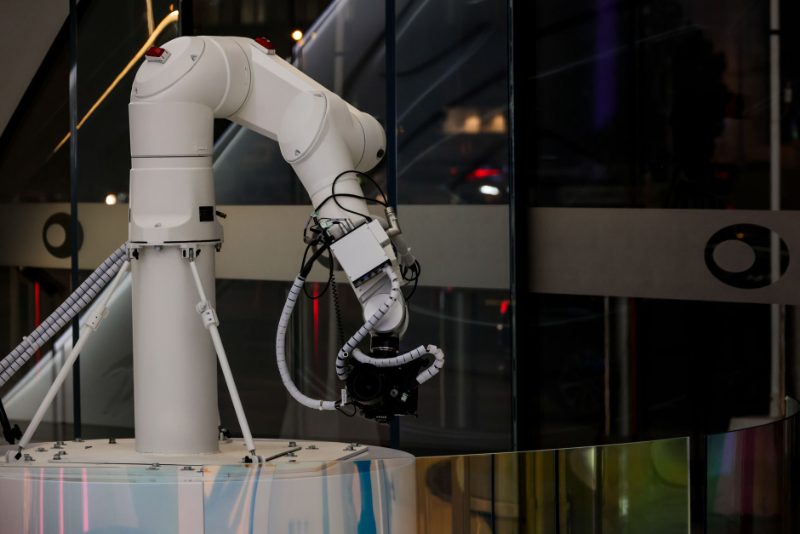
Tata Consultancy Services (TCS) launched the TCS Autonomous Engineering Lab Powered by NVIDIA at its Global Axis campus in Bengaluru on July 15, 2026, marking a major step in the company’s industrial AI strategy. The lab is designed to accelerate the adoption of AI-driven autonomous systems across manufacturing, energy, aerospace, and automotive sectors, combining TCS’s engineering expertise with NVIDIA’s AI computing infrastructure.
The TCS Autonomous Engineering Lab at the Global Axis campus in Bengaluru will serve as a centre of excellence for developing and testing AI models for industrial applications. It brings together NVIDIA’s DGX systems, NVIDIA Omniverse for digital twin simulation, and TCS’s proprietary AI frameworks to create an end-to-end environment for autonomous engineering development. The lab is part of TCS’s strategic partnership with NVIDIA, which was expanded in early 2026 to cover physical AI, agentic AI, and enterprise AI deployment at scale.
What Will the TCS NVIDIA Autonomous Engineering Lab Do?
The lab focuses on three primary capability areas: physical AI for industrial robotics, digital twin simulation for factory and infrastructure design, and agentic AI for autonomous quality control and predictive maintenance. Using NVIDIA’s Omniverse platform, TCS engineers can create virtual replicas of manufacturing plants and run AI training simulations before deploying models on real factory floors. For automotive clients, the lab will develop autonomous inspection systems powered by NVIDIA’s Jetson edge AI platform. For energy clients, AI models will be trained to predict equipment failure in oil and gas infrastructure, potentially reducing unplanned downtime by up to 30%. The lab is also expected to develop AI solutions for India’s growing semiconductor fabrication sector, following the government’s ₹1.27 lakh crore semiconductor mission announced this week.
Why Does This Matter for India’s Manufacturing and IT Industries?
India’s manufacturing sector contributes approximately 17% of GDP, and the government’s Make in India and PLI (Production Linked Incentive) schemes have triggered a wave of factory modernisation that requires AI-enabled automation. TCS, with annual revenues exceeding $30 billion and a workforce of over 600,000, is positioning itself as the primary AI integration partner for India’s industrial transformation. The NVIDIA partnership gives TCS access to cutting-edge GPU compute infrastructure, enabling it to train large-scale industrial AI models domestically rather than relying entirely on cloud-based compute from the United States. This is particularly significant as concerns about data sovereignty in industrial AI grow among government and defence clients.
Industry Reaction and Expert Commentary
The launch was welcomed by India’s engineering and IT industry as a signal that the country’s flagship IT companies are moving up the value chain from AI services to AI product development. TCS CEO K. Krithivasan has previously stated that AI is not a disruption for TCS but a “decade-long opportunity,” and the NVIDIA lab is seen as a concrete step in that direction. Bengaluru-based Mowito, a startup building AI models for industrial robotic arms that raised $3 million this month, called the TCS-NVIDIA collaboration a validation of India’s industrial AI potential. NVIDIA’s Vice President for India operations was present at the launch, reflecting the strategic importance of the Indian market for the world’s most valuable AI hardware company.
What Happens Next?
TCS plans to staff the Autonomous Engineering Lab with an initial team of 500 engineers specialising in AI, robotics, and simulation, with plans to scale to 2,000 professionals by 2027. The lab will open its doors to TCS clients from Q3 2026 (October–December), allowing them to co-develop AI solutions in a sandbox environment before full deployment. TCS has also indicated plans to replicate the lab model in Chennai and Hyderabad by 2027, building a nationwide network of industrial AI centres powered by NVIDIA infrastructure.
Frequently Asked Questions
What is the TCS Autonomous Engineering Lab Powered by NVIDIA?
The TCS Autonomous Engineering Lab Powered by NVIDIA is a dedicated industrial AI research and development centre launched at TCS’s Global Axis campus in Bengaluru on July 15, 2026. It combines NVIDIA’s DGX compute systems, Omniverse digital twin platform, and Jetson edge AI with TCS’s engineering frameworks to develop autonomous systems for manufacturing, automotive, energy, and aerospace sectors.
What is NVIDIA’s role in the TCS Autonomous Engineering Lab?
NVIDIA provides the core AI computing infrastructure for the lab, including DGX GPU systems for AI model training, the Omniverse platform for digital twin simulation, and Jetson edge AI modules for real-time autonomous systems. The lab is part of a broader expanded strategic partnership between TCS and NVIDIA signed in early 2026.
Which industries will benefit from the TCS NVIDIA Autonomous Engineering Lab in India?
The lab primarily targets India’s manufacturing, automotive, energy, aerospace, and semiconductor industries. Use cases include AI-powered quality inspection, predictive maintenance for oil and gas equipment, autonomous factory floor robotics, and digital twin simulation for new plant design — all critical to India’s industrial modernisation agenda under PLI schemes.












Leave a comment