

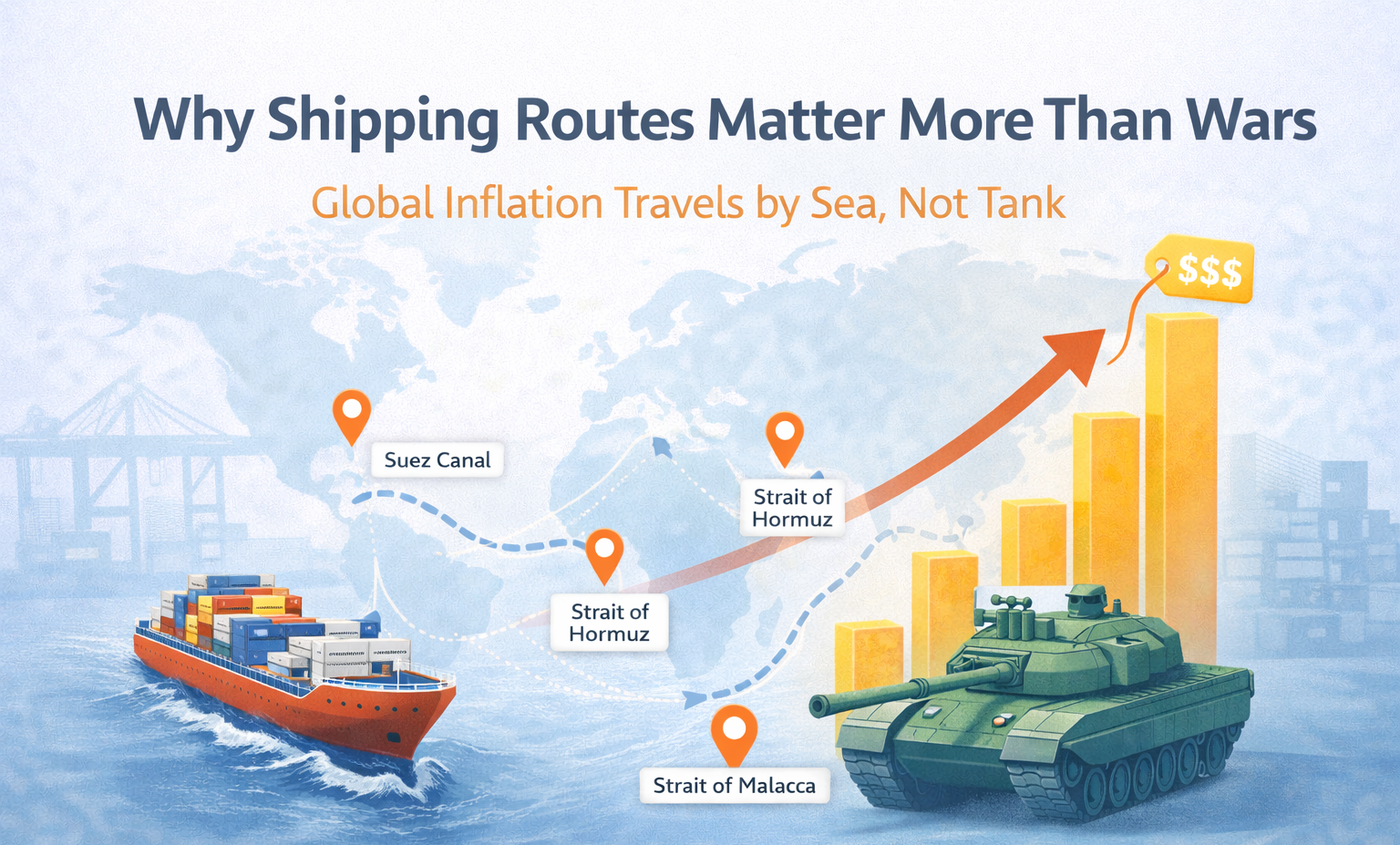
Armed conflicts dominate headlines.
Trade corridors shape economies.
In the modern world, economic power is no longer defined solely by military strength or territorial control. It is increasingly determined by who controls the movement of goods.
Over 90% of global trade is transported by sea. Every smartphone, vehicle component, pharmaceutical ingredient, and food commodity depends on uninterrupted shipping routes.
This makes maritime corridors the most critical infrastructure of the global economy.
Yet they remain largely invisible to the public.
The World’s Most Important Trade Corridors
A small number of narrow maritime passages handle trillions of dollars in trade annually:
- Suez Canal – Connects Asia to Europe
- Strait of Hormuz – Carries nearly 20% of global oil supply
- Bab-el-Mandeb – Links the Red Sea to the Indian Ocean
- Strait of Malacca – Primary route for East Asian trade
- Panama Canal – Bridges Atlantic and Pacific commerce
Disruption at any of these points creates immediate ripple effects across global markets.
These corridors are not merely shipping lanes. They are strategic economic arteries.
When Routes Disrupt, Economies React
Recent disturbances in the Red Sea region demonstrated how fragile the global logistics system has become.
When vessels are forced to reroute:
- Freight costs increase sharply
- Transit times extend by weeks
- Insurance premiums rise
- Fuel prices escalate
- Supply chains experience shortages
In one recent incident, a blocked canal delayed close to $10 billion worth of trade per day.
No missiles were involved.
No borders changed.
Yet the economic impact was global.
How This Impacts Everyday Consumers
Geopolitical tensions influence inflation through logistics.
The sequence is straightforward:
Shipping disruption leads to higher transportation costs.
Higher transportation costs raise import prices.
Rising import prices push up consumer inflation.
This is why instability thousands of kilometers away can affect grocery prices, electronics availability, and fuel costs in India.
Modern inflation travels by container ship.
India’s Emerging Strategic Advantage
India’s geographic position places it near several major global trade routes, offering a significant opportunity.
Government initiatives such as Sagarmala and Gati Shakti aim to strengthen ports, logistics parks, and freight corridors. These investments are not merely infrastructure upgrades—they represent India’s effort to integrate itself more deeply into global supply chains.
As manufacturers diversify away from China, India is positioning itself as a reliable alternative production and logistics hub.
This includes expansion in:
- Port infrastructure
- Coastal manufacturing clusters
- Warehousing networks
- Digital trade platforms
India is building connectivity to capture global commerce.
Opportunities for Industry and Entrepreneurs
This shift creates demand across multiple sectors:
- Logistics technology
- Warehouse automation
- Freight management platforms
- Export facilitation software
- Supply-chain finance
- Port digitisation
Future industrial growth will be driven not only by factories, but by the systems that connect them.
Industrial Front Perspective
Modern power lies in movement.
Countries that control logistics networks shape trade flows. Businesses that optimise supply chains gain competitive advantage.
Understanding shipping routes today is as important as understanding markets.
For founders, investors, and policymakers alike, logistics has become strategy.
Conclusion
Wars may alter borders.
Shipping routes determine prosperity.
In a world increasingly defined by trade resilience, the ability to move goods efficiently has become the foundation of economic strength.











Leave a comment