

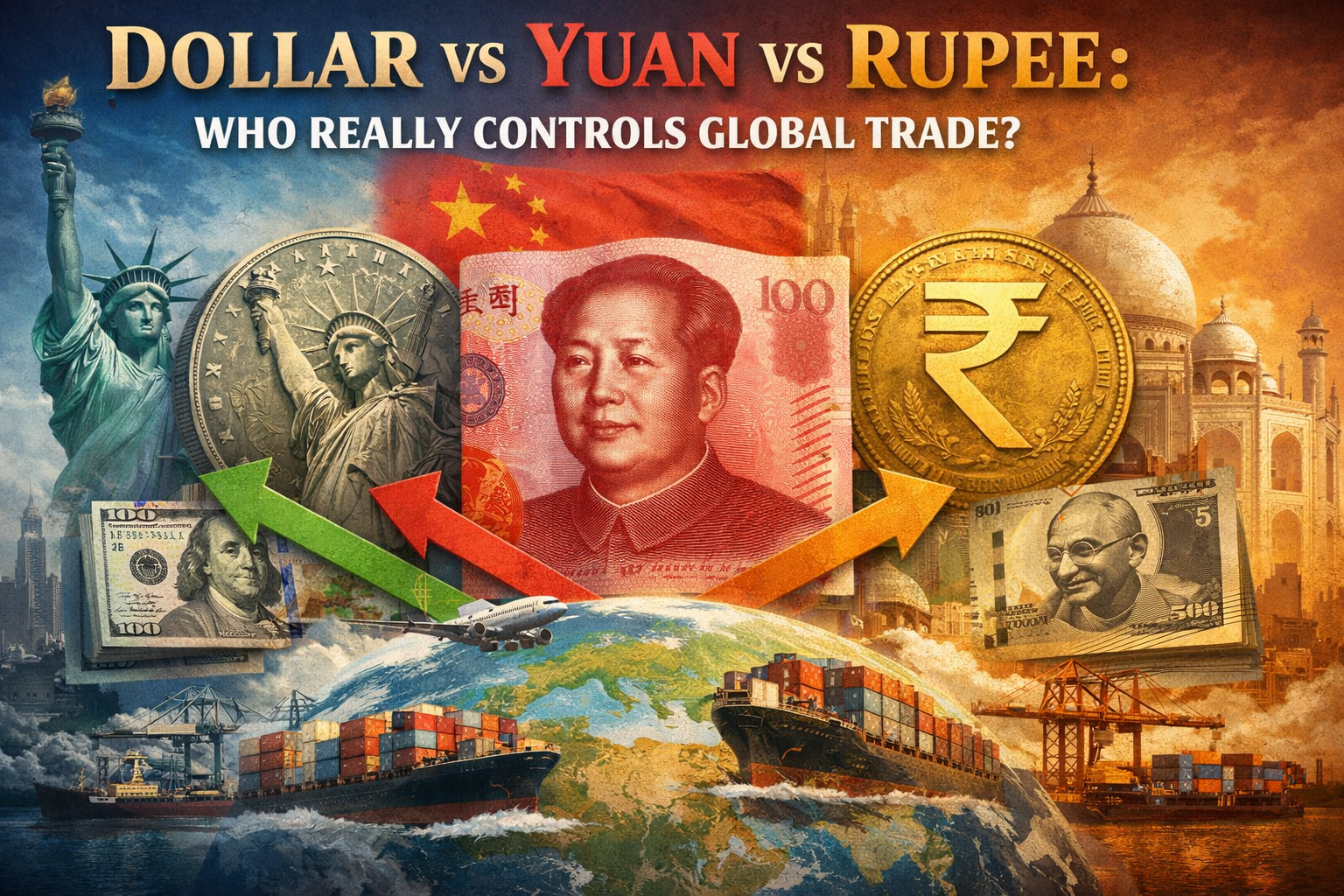
It’s not just currencies. It’s power.
Walk into any business conversation today and you’ll hear three currencies mentioned again and again:
The US Dollar.
The Chinese Yuan.
The Indian Rupee.
On the surface, they look like simple exchange rates.
But underneath, these currencies represent three competing economic visions for how the world should trade.
This is not about money.
This is about control.
The Dollar: The World’s Default Power Tool
Over 80% of global trade is still settled in US dollars.
Oil is priced in dollars.
Shipping contracts use dollars.
Global debt is issued in dollars.
Even countries that don’t like the US still depend on its currency.
Why?
Because the d
ollar offers:
- Deep financial markets
- Stable legal systems
- Massive liquidity
- Global trust built over decades
Every time a country trades in dollars, it indirectly strengthens America’s influence.
That’s why the dollar isn’t just currency.
It’s geopolitical leverage.
When the US raises interest rates, the entire world feels it.
When the US sanctions someone, trade freezes instantly.
That is real power.
The Yuan: China’s Quiet Expansion Strategy
China doesn’t try to dominate headlines.
It dominates supply chains.
Beijing is slowly pushing the yuan into international trade through:
- Belt & Road infrastructure projects
- Bilateral trade agreements
- Direct yuan settlements with Russia, Middle East, Africa
- Digital yuan experiments
China’s strategy is simple:
If you build factories in China,
if you borrow from China,
if you trade with China —
you eventually u
se the yuan.
It’s not aggressive.
It’s gradual.
China doesn’t want to replace the dollar overnight.
It wants parallel systems.
Multiple trade routes.
Multiple payment rails.
Multiple alliances.
The goal is independence from Western financial pressure.
The Rupee: India’s Emerging Opportunity
India is late to this currency game.
But timing matters.
India is now:
- Signing rupee trade agreements with partners
- Promoting INR invoicing for exports
- Expanding UPI internationally
- Building financial rails with Middle East and Africa
Unlike the US or China, India’s strength is not currency dominance.
It’s manufacturing + services + demographic scale.
If India becomes a pr
eferred production hub, the rupee automatically gains relevance.
Currency power always follows industrial power.
Factories first. Finance later.
This Isn’t About Exchange Rates
This is about who controls:
- Supply chains
- Payment systems
- Capital flows
- Energy trade
- Manufacturing hubs
Today:
America controls finance.
China controls production.
India is positioning itself as the alternative factory of the world.
That’s the triangle.
Why This Matters to Founders and Businesses
If you’re building anything connected to exports, logistics, tech, or manufacturing — this directly affects you.
Because:
Dollar domina
nce decides funding costs.
Yuan expansion reshapes Asian supply chains.
Rupee adoption decides India’s export future.
The next decade will reward businesses that understand geopolitics early.
Not after headlines.
The Real Battle: Trust
Currencies succeed because people trust them.
The dollar has trust built over 70 years.
The yuan has state backing but limited openness.
The rupee has growth potential but needs stability and scale.
Whoever earns global trust wins trade influence.
Simple.
Final Thought
The future of global trade won’t belong to one currency.
It will belong to systems.
America owns finance.
China owns factories.
India is building both.
The countries that control production plus payments will shape the next world economy.
And this time, Asia isn’t just participating.
It’s leading.













Leave a comment