

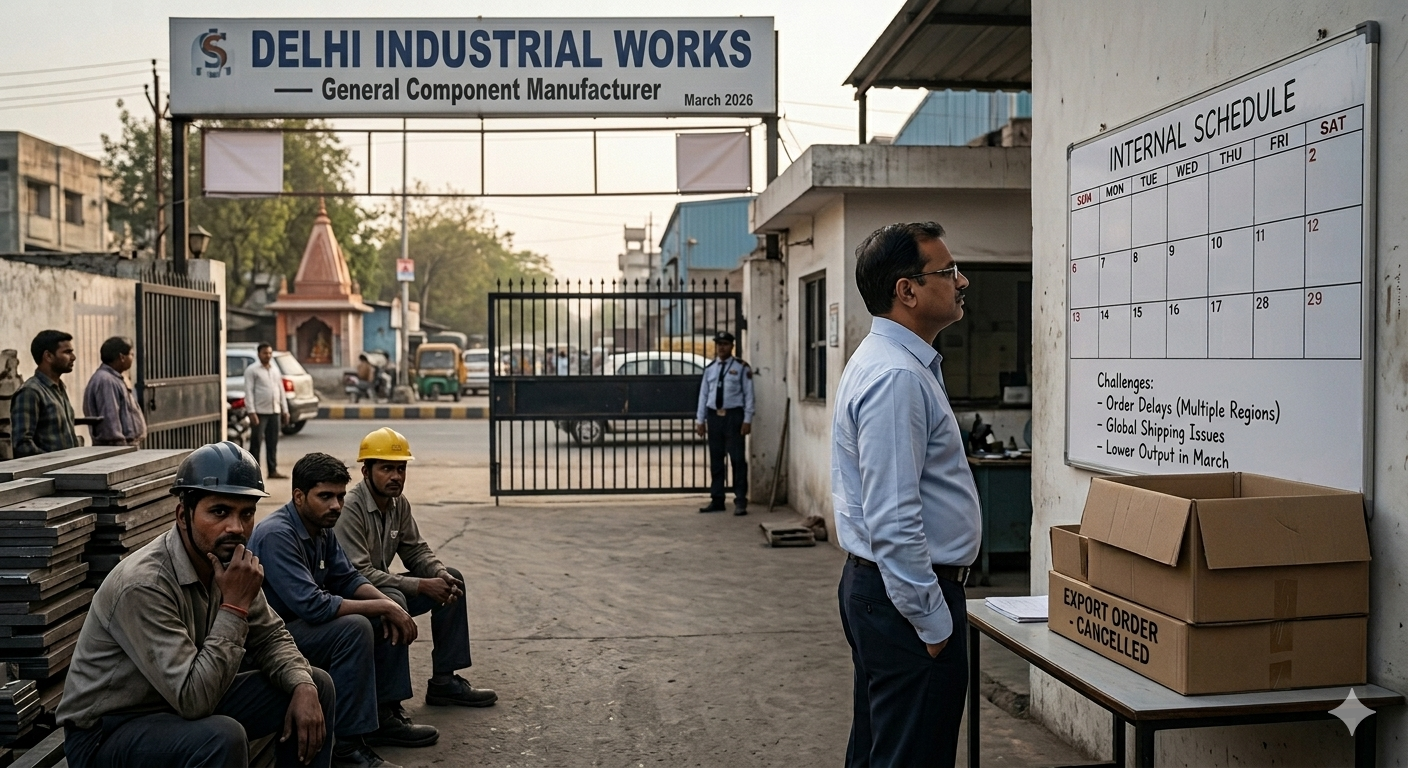
New Delhi, March 24, 2026 — India’s private sector activity fell to its weakest pace in over three and a half years in March 2026, with the HSBC Flash Composite PMI dropping to 56.5 from 58.9 in February, as the ongoing Middle East conflict and surging oil prices dampened domestic demand and pushed cost inflation near a four-year high.
What Happened
The HSBC Flash India Composite Purchasing Managers’ Index (PMI), which tracks combined manufacturing and services output, declined sharply to 56.5 in March — the lowest reading since October 2022. Manufacturing activity slowed to 53.8 from 56.9 in the previous month, while services output eased to 57.2, missing analyst forecasts of 58.3. New orders rose at the slowest pace in more than three years, with domestic demand particularly soft even as international new export orders hit a record high surge.
Companies surveyed cited the Middle East conflict, unstable market conditions, and inflationary pressures as key headwinds dampening growth. The Reserve Bank of India’s March 2026 Bulletin separately flagged a “complex macroeconomic environment” marked by rising global uncertainty, geopolitical tensions, and increased volatility across commodity and financial markets, with cost pressures running near a four-year high across multiple input categories.
Industry Impact
The cooling momentum signals a potential moderation in India’s GDP growth trajectory in the January–March quarter. While the headline Composite PMI remains comfortably above 50 — indicating continued expansion — the pace of deceleration is drawing concern among economists. Sectors heavily reliant on domestic consumption, including consumer goods manufacturing and retail-linked services, bore the brunt of the slowdown, while export-oriented industries benefited from the record international order flows.
On the corporate front, Coal India’s board granted in-principle approval for the listing of subsidiary South Eastern Coalfields Ltd (SECL) through an IPO, involving an offer for sale of up to 25% of Coal India’s stake and a fresh issue of up to 10% equity — a significant divestment development with wide implications for India’s coal sector financing. Separately, Indian Railway Finance Corporation (IRFC) signed a term loan agreement of ₹12,842 crore with HURL (Hindustan Urvarak & Rasayan Ltd) for refinancing of its existing long-term debt, underlining continued capital market activity in India’s infrastructure financing space.
What to Watch
Markets will closely monitor the final HSBC India PMI readings for March, due in early April, alongside the Union government’s fiscal position and any potential monetary policy response from the RBI. A sustained PMI reading below 57 for two consecutive months could prompt analysts to revise India’s FY2026-27 GDP growth forecasts downward. The trajectory of Middle East tensions and crude oil prices remains the single biggest external variable for Indian industry in the near term, with any diplomatic de-escalation likely to provide a meaningful growth tailwind heading into the new fiscal year.
— Industrial Front Desk









Leave a comment