

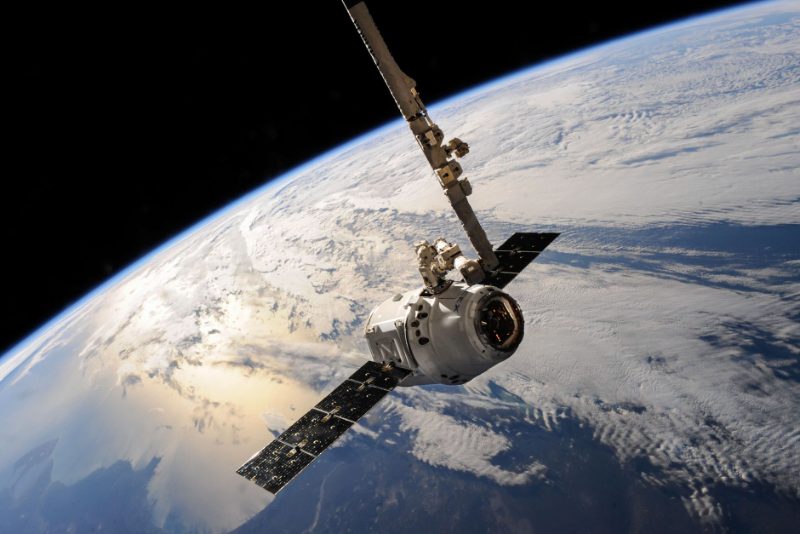
Hyderabad-based space-tech startup TakeMe2Space will launch India’s MOI-1A orbital AI computing satellite aboard a SpaceX Falcon 9 rocket on October 1, 2026, carrying Nvidia Orin NX edge-computing chips that let the satellite analyse data in orbit instead of beaming raw imagery back to Earth. The launch marks a milestone for India’s push into orbital AI computing, a niche where satellites process information onboard rather than relying entirely on ground stations.
MOI-1A weighs under 50 kg and runs on roughly 150 watts of power, according to founder and CEO Ronak Samantray. It will ride to orbit on SpaceX’s Transporter-18 rideshare mission from South Texas, replacing an earlier satellite, MOI-1, that was lost on January 12, 2026 when the third stage of ISRO’s PSLV-C62 rocket failed. TakeMe2Space has already logged 23 customers for the new satellite, including US space-data firm Little Place Labs, spanning use cases in mapping, agriculture, mining, supply chain management, insurance and education.
How Does Orbital AI Computing Actually Work?
Instead of downlinking terabytes of raw satellite imagery for processing on the ground, MOI-1A lets customers load their own AI models directly onto the satellite’s Nvidia Orin NX processors. The models run inference in orbit and only the extracted results, not the raw data, are transmitted back to Earth. For an insurer assessing crop damage or a mining company tracking stockpiles, this cuts both bandwidth costs and turnaround time from days to minutes. TakeMe2Space designs and builds most of MOI-1A’s components in India, sourcing propulsion systems, chips and solar cells externally.
What Does This Mean for Indian Businesses Using AI?
For Indian enterprises in agriculture, mining, logistics and insurance, orbital AI computing signals a shift from waiting on satellite data providers to running proprietary models on infrastructure that never touches the ground. It also reflects a broader trend of India’s private space sector building sovereign, India-designed hardware rather than depending solely on ISRO missions or foreign satellite operators. With India’s space economy targeted to grow sharply this decade, orbital edge-computing ventures like TakeMe2Space could become a template for how domestic AI and space-tech industries converge.
Industry Reaction and Expert Commentary
TakeMe2Space’s approach has drawn attention in the space-tech community for proving out orbital edge computing on a shoestring satellite budget rather than a large geostationary platform. The company’s earlier test satellite, MOI-TD, launched from Sriharikota in December 2024 and completed more than 20 orbital tests, data the company says informed MOI-1A’s design. Industry watchers note that pairing commercial off-the-shelf AI chips like Nvidia’s Orin NX with a compact satellite bus is what makes the economics of in-orbit inference viable for a startup rather than only a national space agency.
The loss of the original MOI-1 satellite in January 2026, when ISRO’s PSLV-C62 third stage failed, was a setback that delayed TakeMe2Space’s commercial rollout by several months. Rebuilding and re-manifesting MOI-1A onto a SpaceX rideshare rather than waiting for the next available ISRO slot reflects a wider pattern among Indian space-tech startups: diversifying launch providers to de-risk timelines, even when it means paying a foreign launch operator instead of a domestic one.
What Happens Next?
MOI-1A is scheduled to launch October 1, 2026 on the Transporter-18 mission. Once in orbit, TakeMe2Space plans to onboard its 23 signed customers and begin commercial data-processing operations. The company has also flagged plans for larger, networked satellite constellations and orbital data-storage services aimed at the financial and defence sectors, positioning itself to compete for a bigger share of India’s growing space-tech ecosystem.
Frequently Asked Questions
What is MOI-1A?
MOI-1A is an orbital AI computing satellite built by Indian startup TakeMe2Space. It uses Nvidia Orin NX chips to run customer AI models in orbit and transmit only processed results rather than raw data.
When and how is MOI-1A launching?
MOI-1A is set to launch on October 1, 2026 aboard a SpaceX Falcon 9 rocket as part of the Transporter-18 rideshare mission from South Texas.
Who are TakeMe2Space’s customers?
TakeMe2Space has signed 23 customers for MOI-1A, including US space-data company Little Place Labs, with applications spanning agriculture, mining, mapping, supply chain management, insurance and education.
Why does in-orbit AI processing matter for industries like agriculture and insurance?
Processing data onboard the satellite means only actionable results, such as a crop-stress alert or a damage estimate, are transmitted to the ground, instead of raw imagery that needs separate downlink and processing. That cuts data costs and delivery time, which matters most for time-sensitive use cases like disaster response, insurance claims and mining stockpile audits.












Leave a comment