

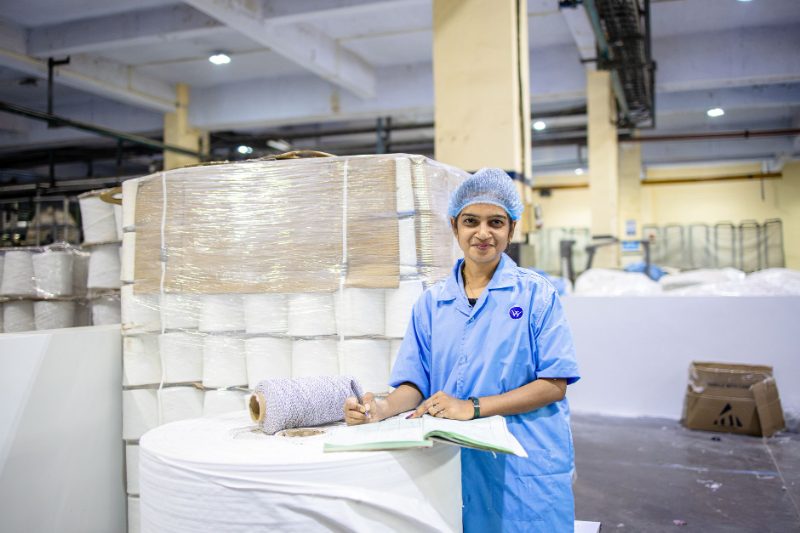
Mohit Paper Mills has marked a significant operational milestone with the commissioning of its new caustic soda plant, enabling full utilisation of its installed paper manufacturing capacity and reducing dependence on external chemical procurement. The Mohit Paper Mills expansion positions the Uttar Pradesh-based company to improve cost efficiency and output consistency across its kraft and writing paper product lines, in a year when India’s paper industry is estimated to be worth ₹90,000–95,000 crore and targeting accelerated capacity utilisation.
Mohit Paper Mills operates in the kraft paper and paperboard segment, supplying primarily to the packaging industry. The caustic soda plant — a key chemical used in the pulping process — had previously been sourced externally, creating supply chain dependency and cost variability. The in-house facility marks the company’s shift toward backward integration, a trend gaining momentum across India’s mid-size paper mills as input cost pressures intensify.
Why Is Backward Integration Critical for India’s Paper Mills in 2026?
India’s paper industry faces a persistent challenge: raw material costs — wood pulp, recovered paper (wastepaper), and process chemicals including caustic soda and chlorine — account for 55–65% of total production costs. Caustic soda prices have been volatile since 2023, spiking during the US-Iran conflict period in early 2026 before correcting. For Mohit Paper Mills, the India paper mill expansion via an in-house caustic soda plant eliminates spot-price exposure on this input and improves batch-to-batch consistency in the bleaching and pulping stages. The move mirrors similar backward integration steps taken by JK Paper (which integrated pulp production), Pudumjee Paper (developing a ₹68,000 MT specialty paper facility at Mahad), and Tamil Nadu Newsprint and Papers (TNPL), which has invested heavily in agro-residue pulping to reduce wood dependency.
How Does This Fit Into India’s Broader Paper Industry Capacity Push?
India’s paper sector spans 850+ mills with installed capacity of 30–32 million tonnes against actual production of approximately 25–26 million tonnes, reflecting 78–83% utilisation — moderate by global standards. The India paper mill expansion wave of 2025-26 is driven primarily by packaging paper demand: e-commerce, food processing, and organised retail are together generating high single-digit to low double-digit volume growth in kraft and corrugated board, far outpacing writing and printing paper. ITC’s Paperboards and Specialty Papers division, India’s largest, reported 11% revenue growth in FY26. West Coast Paper Mills and Century Pulp and Paper are both running at over 90% capacity utilisation in their packaging grades. Full utilisation at Mohit Paper Mills, enabled by the caustic soda plant, adds incremental supply at a time when kraft paper prices have firmed 6–8% in 2026 due to strong demand.
Market Reaction and Industry Response
The commissioning comes as the India paper industry navigates a bifurcated demand environment: packaging paper booming while newsprint and coated printing paper face structural decline from digital media substitution. Analysts at ICRA have rated the packaging paper segment outlook as “positive” for FY2026-27, citing sustained e-commerce volume growth and food processing capacity additions. Pudumjee Paper’s announced specialty paper facility at Mahad (targeting stronger paper bags and food-contact applications) adds to the pipeline of capacity investments that will come online between 2026 and 2028. The Pulp and Paper Times noted that mid-size mills completing backward integration — as Mohit Paper Mills has done — are better positioned to sustain margins through the commodity cycle than those relying on spot chemical procurement.
What Happens Next?
With the caustic soda plant operational, Mohit Paper Mills is expected to run its production lines at rated capacity through the Q2-Q3 FY27 demand peak (festive packaging season). Investors and trade watchers will monitor kraft paper price trends: if packaging demand sustains at current levels and new capacity additions lag, prices could firm further through Q4 FY26. More broadly, the BIS is expected to notify quality standards for food-contact paper packaging by Q3 2026, which could create near-term compliance costs but medium-term pricing power for mills already producing to high-quality standards.
Frequently Asked Questions
What does Mohit Paper Mills’ caustic soda plant milestone mean for production?
The commissioning of Mohit Paper Mills’ in-house caustic soda plant enables full utilisation of the company’s installed paper manufacturing capacity by eliminating external chemical dependency. Caustic soda is a critical input in the pulping and bleaching process; in-house production reduces cost variability and supply chain risk, directly improving margin stability.
How large is India’s paper industry in 2026?
India’s paper industry is estimated to be worth ₹90,000–95,000 crore in 2026, with annual production of approximately 25–26 million tonnes across 850+ mills. Installed capacity stands at 30–32 million tonnes, with packaging paper driving the strongest growth at high single-digit to low double-digit rates annually.
Which paper segment is growing fastest in India in 2026?
Packaging paper and paperboard is India’s fastest-growing paper segment in 2026, fuelled by e-commerce, food processing expansion, and organised retail growth. Writing and printing paper faces structural headwinds from digital substitution, while specialty paper (including food-contact grades, release liners, and filter paper) is also growing strongly, driven by pharmaceutical and industrial demand.











Leave a comment