

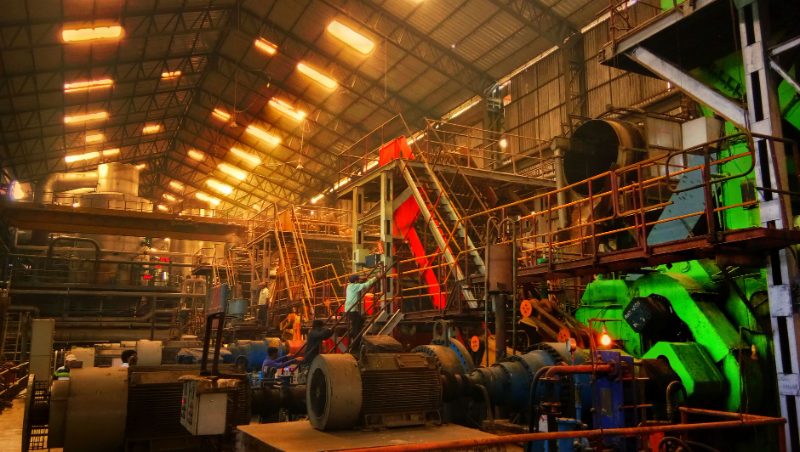
Nippon Paint Holdings has confirmed plans to nearly double its manufacturing footprint in India, adding eight new production plants to its existing network of seven facilities by 2029, in a move that signals renewed confidence in the country’s decorative and industrial coatings demand. The Japanese coatings major is targeting annual revenue of roughly EUR 672 million from its India operations by the end of the decade, positioning the market as one of its fastest-growing outside East Asia.
A Bet on India’s Construction Cycle
The expansion comes as India’s paints and coatings industry, valued at close to USD 12.5 billion in early 2026, continues to post high single-digit growth even as margins across the sector remain under pressure from discounting. Nippon Paint’s calculus rests on the assumption that architectural and decorative coatings, which account for roughly three-quarters of total market demand, will keep expanding alongside housing starts, urban renovation activity and government-backed infrastructure spending. Industrial and protective coatings tied to automotive and manufacturing output are expected to provide a secondary growth leg as factory investment picks up across the country’s emerging industrial corridors.
Competing in a Crowded, Consolidating Market
Nippon Paint’s aggressive capacity build-out arrives at a moment of unusual churn in the Indian coatings landscape. JSW Paints’ acquisition of a majority stake in AkzoNobel India vaulted it into the position of the country’s fourth-largest paint company, while PPG Industries has just extended its decades-old joint venture with Asian Paints for a further 15 years through 2041. Against that backdrop, Nippon Paint’s decision to add eight plants is as much a statement of intent as an operational plan — a signal to distributors, dealers and institutional buyers that the company intends to compete on scale rather than cede ground to consolidating rivals.
Manufacturing Localisation and Cost Pressure
Expanding domestic manufacturing also addresses a structural challenge facing every multinational coatings player operating in India: the need to localise production against a backdrop of volatile input costs. Titanium dioxide, resins and specialty additives are all exposed to global commodity swings, and companies that manufacture closer to demand centres are better placed to manage logistics costs and respond quickly to regional order patterns. Nippon Paint’s new facilities are expected to be distributed across multiple states rather than concentrated in a single hub, mirroring the strategy used by domestic leaders such as Asian Paints and Berger Paints to shorten delivery lead times to tier-2 and tier-3 markets.
Market Reaction and Sector Implications
Analysts tracking the coatings sector note that capacity expansion announcements of this scale typically take years to translate into revenue, and the near-term impact on pricing is likely to be limited. However, the move adds to a growing body of evidence that global paint majors view India as a structural growth market rather than a cyclical one, even as the domestic industry grapples with margin compression from aggressive rebates and price cuts. For India’s paint ancillary industries — resin manufacturers, packaging suppliers and pigment producers — the announcement points to steady, multi-year demand for capital goods and raw material supply contracts tied to new plant construction.
What Comes Next
Nippon Paint has not yet disclosed the specific locations for all eight planned facilities, though industry watchers expect announcements to follow through 2026 and 2027 as land acquisition and regulatory approvals progress. With Paint India 2026 having already showcased a wave of sustainability-focused product launches earlier this year, the broader industry consensus is that capacity, formulation innovation and distribution reach will jointly determine which players consolidate share as India’s coatings market pushes toward its projected USD 16.5 billion valuation by the end of the decade.












Leave a comment