

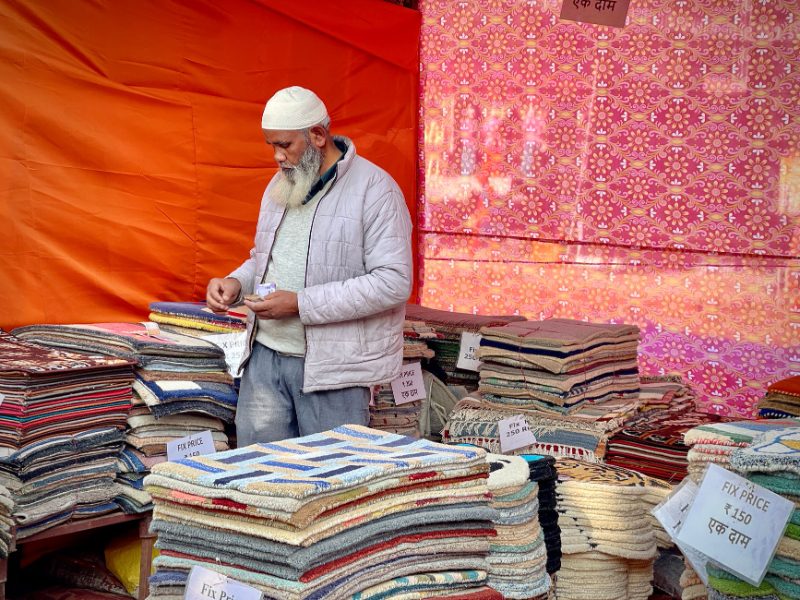
Bharat Tex 2026, India’s largest global textile trade fair, opens July 14–17 at Bharat Mandapam, New Delhi, bringing together 7,000 international buyers, 1.3 lakh trade visitors, and 1,600 exhibitors to showcase the complete textile value chain under one roof. The Bharat Tex 2026 event, launched by Union Textiles Minister Giriraj Singh, marks a strategic effort to position India as a USD 350 billion textile economy with USD 100 billion in annual exports by 2030.
The four-day event spans fibre, yarn, fabric, apparel, home textiles, technical textiles, and ancillary industries, with international participation from 14 countries including the United States, United Kingdom, Japan, Portugal, Spain, South Korea, and South Africa. Over 3,500 curated B2B meetings are scheduled between Indian manufacturers and global buyers, making it one of the most commercially intensive textile sourcing events held on Indian soil.
What Makes Bharat Tex 2026 a Landmark Event for India’s Textile Sector?
Bharat Tex 2026 consolidates what were previously fragmented regional exhibitions into a single unified national showcase, covering the full textile supply chain from raw fibre to finished fashion. The 2026 edition features a dedicated technical textiles pavilion—reflecting the government’s ambition to grow India’s technical textiles market from $22 billion to $40 billion by 2030 through the National Technical Textiles Mission (NTTM). The event also highlights India’s sustainability credentials, with pavilions dedicated to organic cotton from Gujarat and Rajasthan, recycled polyester from Surat’s synthetic textiles cluster, and handloom heritage products from Varanasi, Pochampally, and Assam. Union Minister Giriraj Singh used the launch to announce that the government will extend the Remission of Duties and Taxes on Exported Products (RoDTEP) scheme for textiles for an additional three years, providing exporters with duty rebates worth an estimated Rs. 6,500 crore annually.
How Is India Positioned to Achieve $100 Billion in Textile Exports by 2030?
India’s textile and apparel exports stood at approximately $35–37 billion in FY25, requiring nearly a tripling over five years to reach the USD 100 billion target. Bharat Tex 2026 is positioned as a key catalyst by creating direct sourcing relationships between Indian manufacturers and global retailers. Three structural advantages underpin India’s export ambition. First, free trade agreements (FTAs) with the UAE (operational since 2022), Australia, and the UK (signed in 2025) provide Indian textiles preferential or zero-duty market access across a combined market worth USD 465 billion. Second, the China+1 strategy has prompted brands including H&M, Zara parent Inditex, and PVH Corp to actively diversify sourcing to India. Third, India’s production-linked incentive scheme for man-made fibre (MMF) textiles and technical textiles is driving investment in synthetic and blended fabric manufacturing in textile parks across Tamil Nadu, Gujarat, and Telangana.
Market Reaction and Industry Response
The Confederation of Indian Textile Industry (CITI) has set an ambitious target of securing Rs. 25,000 crore in new investment commitments at Bharat Tex 2026, following Rs. 10,000 crore secured at Bharat Tex 2024. States including Maharashtra, Tamil Nadu, Telangana, and Gujarat are competing to attract textile investments with dedicated pavilions showcasing state-specific incentives. The Tiruppur Exporters Association—representing India’s largest knitwear hub, which exported Rs. 28,600 crore in FY25—is using the event to connect with European buyers seeking compliance with the EU’s Corporate Sustainability Reporting Directive (CSRD), which requires supply chain sustainability data from 2026 onwards.
What Happens Next After Bharat Tex 2026?
The business generated at Bharat Tex 2026 will take 6–18 months to convert into confirmed orders, meaning the event’s commercial impact will manifest in India’s textile export data from Q4 FY26 onwards. The Ministry of Textiles plans to use the event’s success as a springboard for India’s textile export promotion campaign in Europe and North America in Q3 2026, targeting buyers in Germany, France, and the United States. The next Bharat Tex is expected in 2028, with ambitions to surpass 10,000 international buyers as India’s textile manufacturing ecosystem matures.
Frequently Asked Questions
When and where is Bharat Tex 2026 being held?
Bharat Tex 2026 is being held from July 14–17, 2026 at Bharat Mandapam, New Delhi. The event is organised by the Textile Export Promotion Councils of India under the aegis of the Ministry of Textiles and features 1,600 exhibitors, 7,000 international buyers, and over 1.3 lakh trade visitors.
What is India’s textile export target by 2030?
India has set a target of achieving USD 100 billion in textile and apparel exports by 2030, as part of an overall USD 350 billion textile economy vision. India’s FY25 textile exports were approximately $35–37 billion, and Bharat Tex 2026 aims to accelerate sourcing diversification as a key step toward this goal.
Which free trade agreements support India’s textile export growth?
India’s FTAs with the UAE, Australia, and the United Kingdom provide preferential or zero-duty access to textile markets worth a combined USD 465 billion. The India-EU FTA, currently under negotiation, could be the single largest catalyst for India’s textile export growth if concluded in 2026–27.







Leave a comment