

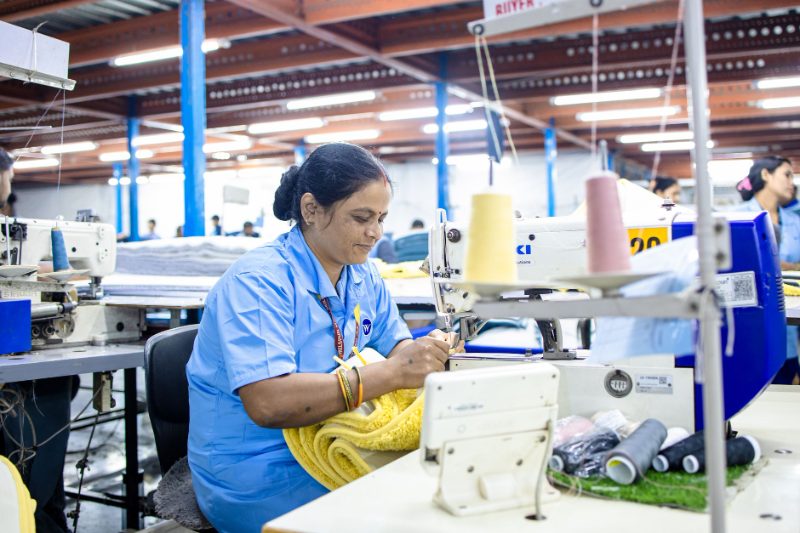
India’s textile industry is leveraging a growing network of free trade agreements to accelerate exports, with FTAs covering the UAE, Australia, and the United Kingdom now providing preferential or zero-duty market access to a combined market worth USD 465 billion. India textile exports 2026 are projected to grow 12–15% year-on-year as the China+1 sourcing shift gains momentum and Indian manufacturers invest in sustainability credentials demanded by European and American buyers.
India’s textile and apparel exports reached approximately Rs. 2.9 lakh crore ($35–37 billion) in FY25. The Ministry of Textiles has set an ambitious target of USD 100 billion in textile exports by 2030—a near-tripling that requires sustained double-digit export growth every year. With Bharat Tex 2026 generating fresh buyer interest and new FTAs reducing cost barriers, the 2026–27 fiscal year is emerging as a critical inflection point for the sector.
How Are Free Trade Agreements Boosting India’s Textile Exports in 2026?
The India-UAE Comprehensive Economic Partnership Agreement (CEPA), operational since May 2022, provides zero-duty access for Indian textile and apparel products into the UAE—which serves as a re-export hub to 50+ Middle Eastern and African markets. Indian knitwear exports to the UAE surged 34% in FY25 following CEPA implementation. The India-Australia Economic Cooperation and Trade Agreement (ECTA) gives Indian garments preferential access to Australia, reducing duties from 5–10% to zero on 85% of textile tariff lines. Most significantly, the India-UK FTA, signed in late 2025, is expected to eliminate the 12% average duty on Indian textiles entering the UK market—a saving worth approximately Rs. 2,000 crore annually for exporters. The Tiruppur Exporters Association estimates that the UK FTA alone will add $1.5 billion to India’s annual apparel export revenues by FY28.
What Is Driving the China+1 Sourcing Shift Toward India in Textiles?
Global brands accelerated their India textile sourcing in 2025–26 as geopolitical tensions, US tariff measures on Chinese goods, and ESG compliance requirements made China-only sourcing strategically risky. H&M expanded its India sourcing by 28% in FY25, making India its second-largest sourcing destination after Bangladesh. PVH Corp (Calvin Klein, Tommy Hilfiger) and VF Corporation have both announced multi-year sourcing expansion agreements with Indian manufacturers in Tiruppur, Bengaluru, and Noida. Walmart’s sourcing from India grew to $3 billion in FY25, with the company targeting $10 billion by 2030. India’s advantages—lower labour costs than China, English-language proficiency, democratic governance, and an established banking and logistics infrastructure—make it the default China+1 destination for most categories of textile and apparel sourcing.
Market Reaction and Industry Response
Indian listed textile companies including Page Industries, KPR Mill, Vardhman Textiles, and Welspun India have outperformed broader markets in 2026, reflecting investor confidence in the export growth story. KPR Mill’s stock has risen approximately 22% year-to-date in 2026 as the company benefits from both FTA-driven export growth and PLI scheme incentives for MMF textiles. Industry bodies are urging the government to fast-track the India-EU FTA, currently under negotiation, which would open a market worth EUR 375 billion—potentially the single largest export opportunity in India’s textile history. The Ministry of Commerce is targeting conclusion of negotiations by December 2026.
What Happens Next for India’s Textile Export Sector?
The second half of FY27 is expected to show the clearest evidence of FTA-driven export acceleration, as annual data captures the full year impact of the India-UK FTA. The government’s RoDTEP extension for textiles—worth an estimated Rs. 6,500 crore annually—will continue to support export competitiveness. Domestic capacity investment in man-made fibre textiles under the PLI scheme is expected to add 2.5 lakh MT of polyester yarn and fabric capacity by FY27, addressing a structural gap that has previously capped India’s share in synthetic textile exports, a category dominated by China, Vietnam, and Bangladesh.
Frequently Asked Questions
What is India’s textile export target for 2030?
India’s Ministry of Textiles has set a target of USD 100 billion in textile and apparel exports by 2030, as part of a USD 350 billion overall textile economy vision. FY25 exports were $35–37 billion, requiring an average annual growth of 12–15% to achieve the 2030 goal.
Which free trade agreements benefit India’s textile exporters the most?
The India-UAE CEPA (operational 2022), India-Australia ECTA, and India-UK FTA (signed 2025) are the three most impactful agreements for textile exporters. Together they open markets worth USD 465 billion with preferential duty rates. The anticipated India-EU FTA could dwarf all previous agreements, covering a EUR 375 billion market.
How is India benefiting from the China+1 sourcing strategy in textiles?
Global brands including H&M, PVH Corp, VF Corporation, and Walmart are actively diversifying textile sourcing to India from China. H&M increased India sourcing by 28% in FY25, while Walmart is targeting $10 billion in India sourcing by 2030 (up from $3 billion in FY25). India benefits from competitive labour costs, English proficiency, ESG compliance infrastructure, and democratic governance.









Leave a comment