

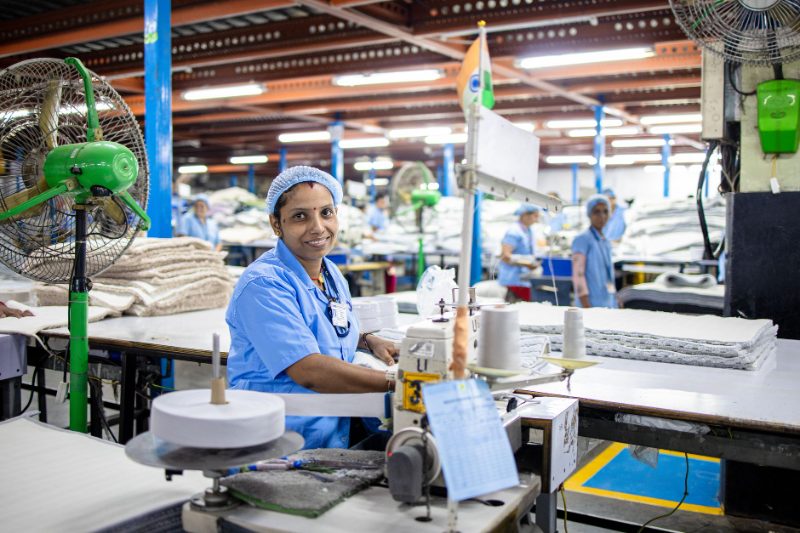
India’s textile and apparel exports, including handicrafts, crossed Rs 3.25 lakh crore in FY26, rising 1.8% to Rs 3,25,339 crore from Rs 3,19,573.2 crore in FY25, the government told the Lok Sabha this week. Minister of State for Textiles Pabitra Margherita shared the figures in a written reply, noting that India recorded export growth in more than 100 countries during the year, a sign of broadening demand beyond the traditional US and EU markets.
The data, released around July 28, 2026, comes as the ministry rolls out a fresh set of support measures for the sector, including a temporary customs duty exemption on cotton imports under Customs Tariff Heading 5201 from June 1 to October 31, 2026, and a newly approved Mission for Cotton Productivity covering 2026-27 to 2030-31. Together, the measures are aimed at easing raw material costs for spinners and improving the quality and yield of India’s domestic cotton crop.
Why Did India’s Textile Exports Cross Rs 3.25 Lakh Crore?
The 1.8% rise in India’s textile and apparel exports to Rs 3.25 lakh crore in FY26 reflects steady demand recovery in Western markets alongside diversification into new destinations, with the government citing growth in over 100 countries. Continued support from schemes such as the PM Mega Integrated Textile Region and Apparel (PM MITRA) Parks, the Production Linked Incentive (PLI) Scheme for Textiles, and the National Technical Textiles Mission has helped exporters add capacity and move up the value chain into technical and man-made fibre textiles. The cotton import duty exemption, extended through October 2026, has also helped spinners manage input costs during a year of volatile domestic cotton prices.
What Does This Mean for India’s Textile Industry?
The export data signals that India’s textile sector, one of the country’s largest employers, is holding steady growth momentum even as global apparel demand remains uneven and competition from Bangladesh and Vietnam persists. Companies such as Welspun Living, Trident, Vardhman Textiles, KPR Mill, Gokaldas Exports and Indo Count Industries are all positioning for a stronger FY27, with several management teams citing new free trade agreements and supply-chain diversification away from China as tailwinds. The newly approved Mission for Cotton Productivity is particularly significant for the spinning segment, which has struggled with inconsistent domestic cotton quality and yields in recent years.
Market Reaction and Industry Response
The Apparel Export Promotion Council (AEPC) welcomed the government’s continued policy support, with Chairman Dr. A. Sakthivel earlier backing Commerce Minister Piyush Goyal’s call for the textile sector to contribute meaningfully to India’s USD 1 trillion export target for FY27. Industry bodies have also sought additional support for specific clusters, including a dedicated PM MITRA Park for the Tiruppur knitwear hub. Listed textile stocks have seen periods of sharp rallies through 2026 on trade-deal optimism, though they have also shown volatility tied to tariff headlines from the US.
What Happens Next?
The textile ministry’s Mission for Cotton Productivity will begin rolling out through FY27, with the government targeting measurable improvements in cotton yield and quality over its five-year run through 2030-31. Exporters will be watching the outcome of ongoing India-US and India-EU trade negotiations, both of which could materially affect tariff treatment for Indian textile and apparel shipments. The cotton duty exemption’s scheduled expiry on October 31, 2026, will also be a key date for spinners assessing input-cost planning for the rest of the fiscal year.
Frequently Asked Questions
How much did India’s textile and apparel exports grow in FY26?
India’s textile and apparel exports, including handicrafts, rose 1.8% to Rs 3,25,339 crore in FY26 from Rs 3,19,573.2 crore in FY25, with growth recorded in more than 100 export markets.
What government schemes are supporting India’s textile exports?
Key schemes include the PM MITRA Parks, the PLI Scheme for Textiles, the National Technical Textiles Mission, SAMARTH, and a temporary customs duty exemption on cotton imports through October 31, 2026.
What is the Mission for Cotton Productivity?
It is a newly approved government program covering 2026-27 to 2030-31 aimed at improving cotton yield, quality and productivity to address long-standing bottlenecks in India’s cotton and textile value chain.









Leave a comment