

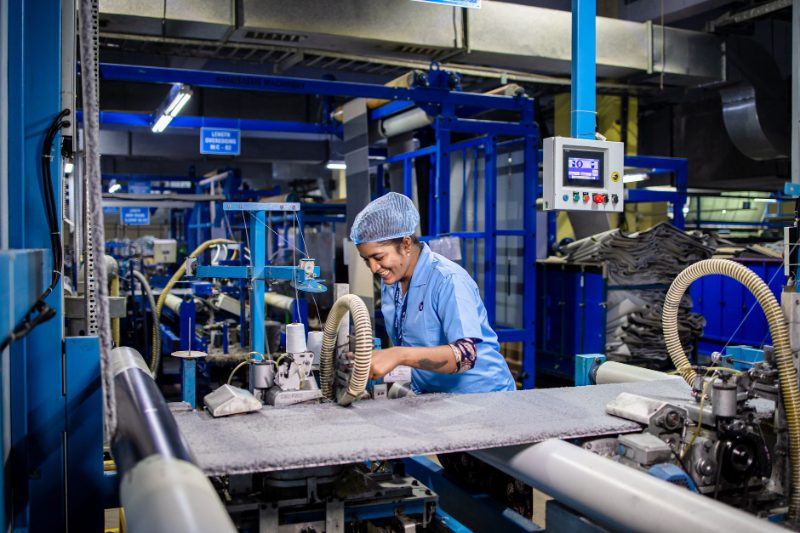
India’s chronic PVC deficit — currently estimated at 2.5 million tonnes per annum — is set to narrow significantly by 2027 as Reliance Industries’ 1.5 MTPA PVC complex and Adani Group’s 2 MTPA PVC build-out move toward commissioning. The twin capacity additions represent the largest domestic PVC investment cycle in India’s plastics industry history, targeting a market that currently imports the bulk of its PVC requirements for pipes, cables, packaging, and construction applications.
India’s plastics industry, valued at USD 47.04 billion in 2026 and projected to reach USD 63.69 billion by 2031 (CAGR of 6.24%), has long been constrained by insufficient domestic PVC production. The upcoming capacity additions by India’s two largest conglomerates signal a structural shift that could redefine import dependency in one of the world’s fastest-growing polymer markets.
Why Is India Investing So Heavily in Domestic PVC Production?
PVC (polyvinyl chloride) is one of India’s most widely consumed polymers, used in agriculture pipes, electrical cable insulation, flooring, window profiles, and packaging. India currently imports over 2 million tonnes of PVC annually, primarily from China, the United States, and the Middle East — at a cost that strains the country’s trade balance and exposes manufacturers to import price volatility and supply chain disruptions. The government’s push for import substitution under Aatmanirbhar Bharat, combined with anti-dumping investigations on Chinese PVC, has created strong policy tailwinds for domestic capacity expansion.
What Scale Are the Reliance and Adani PVC Projects?
Reliance Industries’ 1.5 million tonne per annum (MTPA) PVC facility, integrated within its Jamnagar refining-petrochemical complex in Gujarat, is expected to come online by late 2026 or early 2027. Adani Group’s 2 MTPA PVC project — part of its broader petrochemicals strategy — has been framed as a long-term play to capture India’s growing PVC demand for infrastructure and agriculture. Together, these two projects could add 3.5 MTPA of domestic PVC capacity, potentially eliminating the current 2.5 million-tonne supply gap and positioning India as a net PVC exporter within the decade.
Market Reaction and Industry Response
Existing PVC compounders, processors, and pipe manufacturers — concentrated in Gujarat, Maharashtra, and Tamil Nadu — are watching the capacity additions with cautious optimism. Domestic PVC availability at competitive prices would reduce their raw material costs and improve planning certainty. However, market participants note that the transition will take 18–24 months, during which import dependence will remain high. Polymer price trackers note that global PVC prices have stabilised in mid-2026 after a volatile 2025, providing some relief to downstream processors in the interim.
What Happens Next?
The commissioning timelines for both projects — Reliance and Adani — will be closely tracked through 2026 and into 2027. Any delays due to equipment procurement, regulatory approvals, or financing could extend India’s import window. Industry body PLEXCONCIL (Plastics Export Promotion Council) has flagged that downstream export competitiveness in processed plastics depends on timely domestic PVC availability. Investors will also monitor whether the new capacity triggers pricing rationalisation or consolidation in India’s fragmented PVC processing sector.
Frequently Asked Questions
What is India’s current PVC supply deficit?
India faces a PVC supply deficit of approximately 2.5 million tonnes per annum. The country relies heavily on imports — primarily from China and the Middle East — to meet demand from the pipes, cables, packaging, and construction sectors. Reliance and Adani’s planned capacity additions are expected to close this gap by 2027.
What is the size of India’s plastics industry in 2026?
India’s plastics industry is valued at approximately USD 47.04 billion in 2026 and is projected to grow to USD 63.69 billion by 2031, at a CAGR of 6.24%. PVC, polyethylene, and polypropylene are the largest polymer segments by volume.
How will Reliance’s PVC plant affect polymer prices in India?
When Reliance Industries’ 1.5 MTPA PVC plant comes online — expected by late 2026 or early 2027 — it is likely to put downward pressure on domestic PVC prices, benefiting downstream pipe manufacturers and cable producers. However, the full impact on pricing will depend on global PVC trade dynamics and the pace of Adani’s parallel project commissioning.









Leave a comment