

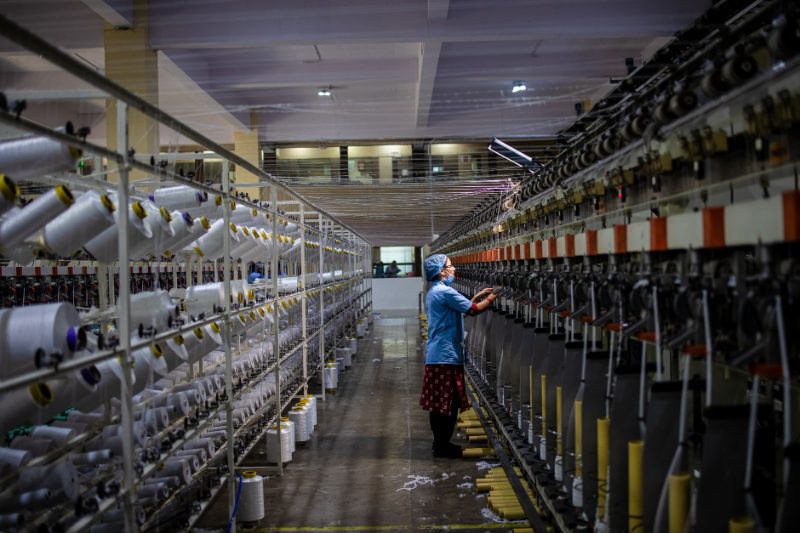
India’s textile stocks have surged up to 20% following the India-US trade deal announced in early 2026, which reduced the US reciprocal tariff on Indian goods — including textiles and apparel — from 25% to 18%, effective from a negotiated implementation date. The India-US trade deal textile impact has been immediate and substantial: a Bloomberg-compiled equal-weight gauge of eight major textile exporters has climbed more than 30% year-to-date in 2026, compared to an 8% decline in the benchmark NSE Nifty 50 Index, making the sector one of India’s best-performing stock segments this calendar year.
The trade deal, announced following a meeting between Prime Minister Narendra Modi and President Donald Trump in February 2026, covers a broad basket of Indian goods, with textiles and apparel, leather and footwear, and plastic and rubber products among the sectors most directly benefiting from the tariff reduction. The US is India’s largest export market for textiles and garments, with bilateral trade in these categories exceeding USD 9 billion annually.
How Does the India-US Trade Deal Benefit Indian Textile Exporters?
The reduction in the US reciprocal tariff from 25% to 18% on Indian textiles and apparel translates directly into improved price competitiveness vis-à-vis competitors like Bangladesh, Vietnam, and China in the US market. For Indian T-shirt, bed linen, and towel manufacturers — who supply global retailers like Walmart, Target, and Amazon — a 7 percentage point tariff advantage can be the difference between winning and losing large sourcing contracts. Companies including K P R Mill, Garware Technical Fibres, Welspun Living, Vardhman Textiles, and Trident saw stock gains of 19–20% on the day the trade deal terms were confirmed. Analysts at multiple brokerages have upgraded their revenue growth forecasts for these companies by 8–12% for FY27, citing accelerated export order inflows.
Which Indian Textile Companies Are Biggest Beneficiaries?
Home textile exporters — particularly in Trident’s towel and bed linen divisions, Welspun Living’s terry products, and Indo Count Industries’ sheeting — are among the most direct beneficiaries, as these categories compete most intensely with Bangladesh and Pakistan suppliers in the US. Technical textiles manufacturers like Garware Technical Fibres (fishing nets, geosynthetics) also benefit from the tariff reduction. Vertically integrated spinning and apparel companies including K P R Mill, Vardhman Textiles, and Page Industries are expected to gain market share as US buyers reallocate sourcing from countries facing higher tariff rates. The Confederation of Indian Textile Industry (CITI) estimates the trade deal could add USD 1.5–2 billion to India’s annual textile and apparel exports to the US by FY28.
Market Reaction and Industry Response
The stock market reaction has been emphatic: the Bloomberg textile exporter gauge’s 30%+ year-to-date gain vastly outperforms the broader market. The sector’s outperformance is attracting institutional investor attention, with foreign portfolio investors (FPIs) increasing their holdings in listed textile companies through Q1 and Q2 FY27. However, CITI has also flagged risks: a 25% US tariff is still expected to apply from August 7, 2026, on certain goods not covered by the deal’s Phase 1 implementation, and any escalation in the US-India trade relationship could reverse sentiment. The industry body is lobbying for full tariff normalisation to 10% or below to be part of a comprehensive bilateral trade agreement expected later in 2026.
What Happens Next?
The next major catalyst for India’s textile sector is Bharat Tex 2026, India’s largest global textile expo, scheduled for July 14–17, 2026 at Bharat Mandapam, New Delhi. The event will bring together 7,000+ international buyers, 1.3 lakh trade visitors, and 1,600 exhibitors — a platform for Indian manufacturers to translate the trade deal’s tariff advantage into concrete sourcing contracts. Comprehensive bilateral trade agreement negotiations between India and the US, which include deeper textile tariff concessions, are expected to advance through Q3 2026.
Frequently Asked Questions
What is the new US tariff on Indian textiles after the trade deal?
Under the India-US trade deal announced in February 2026, the US reciprocal tariff on Indian textiles and apparel was reduced from 25% to 18%. This 7 percentage point reduction significantly improves India’s price competitiveness against Bangladesh, Vietnam, and other Asian textile suppliers in the US market, and has triggered an estimated 19–20% rally in major Indian textile stocks.
Which Indian textile stocks gained most from the US trade deal?
K P R Mill surged 20%, Garware Technical Fibres gained 20%, Welspun Living jumped 19.85%, Vardhman Textiles rose 19.60%, and Trident climbed 19.52% on the BSE on the day the trade deal terms were confirmed. The broader Bloomberg textile exporter gauge has climbed over 30% year-to-date in 2026, making it India’s best-performing major sector index.
What is CITI’s estimate of the trade deal’s impact on India’s textile exports?
The Confederation of Indian Textile Industry (CITI) estimates the India-US trade deal could add USD 1.5–2 billion to India’s annual textile and apparel exports to the US by FY28, as Indian manufacturers capture market share from higher-tariffed competitors. CITI is additionally pushing for full tariff normalisation to 10% or below as part of a comprehensive bilateral trade agreement.










Leave a comment