

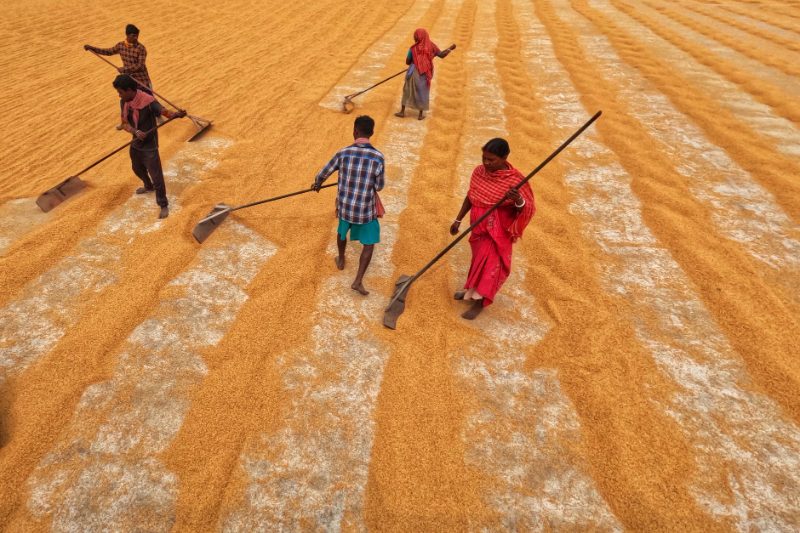
India’s central government has formally notified a floor wage of ₹300 per day under the Viksit Bharat-Guarantee for Rozgar and Ajeevika Mission (Gramin) Act, 2025, effective July 1, 2026, marking the most substantial overhaul of the country’s rural employment guarantee framework in two decades. The new legislation, referred to in policy circles as VB-G RAM G, formally supersedes the Mahatma Gandhi National Rural Employment Guarantee Act (MGNREGA) of 2005, one of the world’s largest public employment programmes.
From MGNREGA to a Guarantee 2.0
MGNREGA guaranteed 100 days of unskilled manual work annually to rural households, and over its lifetime became both a political touchstone and a fiscal lightning rod, credited with reducing distress migration during agrarian downturns while drawing criticism over wage payment delays, leakages and stagnant real wages that failed to keep pace with inflation in several states. The new Act retains the core guarantee architecture but introduces a uniform national floor wage, standardises payment timelines, and reportedly links a portion of works undertaken to rural infrastructure and livelihood-generation projects rather than purely asset-neutral labour.
Officials familiar with the transition say the rebranding to “Viksit Bharat-Guarantee for Rozgar and Ajeevika Mission” is intentional, tying the scheme explicitly to the government’s Viksit Bharat (Developed India) 2047 vision, which frames rural income security as a stepping stone toward broader economic self-reliance rather than a standalone welfare measure.
Fiscal and Economic Implications
The shift carries meaningful fiscal implications. MGNREGA’s budgetary allocation has fluctuated year to year, often requiring supplementary grants when demand for work surged beyond initial estimates, particularly during agricultural distress or the pandemic years. A uniform ₹300 floor wage — higher than the effective wage rate in several states under the old scheme — is likely to push up the overall wage bill, even as it aims to improve real incomes for rural households facing persistent food and fuel inflation.
Economists tracking rural demand note that higher assured wages could support consumption in the rural economy, a segment that has lagged urban demand growth in recent quarters. At the same time, state governments, many of which co-administer the scheme, will need to recalibrate their own labour budgets and works planning to align with the new floor wage and revised implementation guidelines.
Reaction from Stakeholders
Farmer groups and rural labour unions have offered a cautiously positive response, welcoming the wage increase while pressing the government for assurances on timely fund transfers — historically one of the biggest sources of grievance under MGNREGA. Opposition parties, who have long accused the Centre of underfunding the erstwhile scheme, are likely to scrutinise budgetary allocations for the new Act closely in the upcoming monsoon session of Parliament.
Industry observers watching rural labour markets say the reform’s real test will come during the kharif and rabi crop cycles, when demand for guaranteed work typically peaks. If the new framework can deliver on both higher wages and faster payments, it could meaningfully reshape rural income security in India — but if implementation falters, it risks repeating the same administrative bottlenecks that dogged its predecessor for two decades.











Leave a comment