

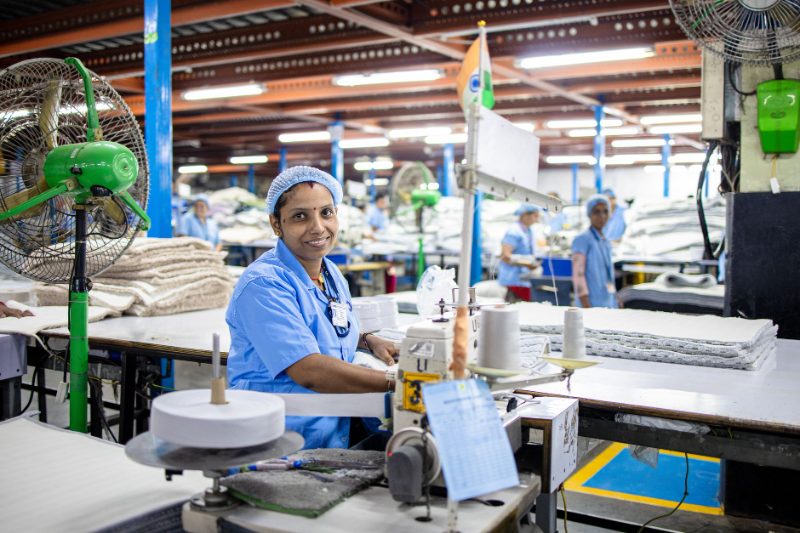
Union Textiles Minister Giriraj Singh unveiled the ‘India Textiles & Apparel CXO Blueprint 2030’ at Bharat Tex 2026 in New Delhi, setting out a roadmap to nearly triple India’s textile and apparel exports to $100 billion by 2030. The report, prepared jointly by the Clothing Manufacturers Association of India (CMAI) and the Global Alliance for Textile Sustainability (GATS), was released at the Sustainability & Circularity Impact Pavilion during the four-day trade event that ran from July 14 to 17, 2026.
Bharat Tex 2026, held at Bharat Mandapam, brought together more than 60,000 participants from 130 countries, including over 1,600 exhibitors and 7,000-plus international buyers. The Blueprint’s headline target sits inside a larger ambition: a $350 billion textile market by 2030, made up of $100 billion in exports and $250 billion in domestic consumption.
Why Is India Targeting $100 Billion in Textile Exports by 2030?
India’s textile and apparel exports have been stuck near $40 billion for six consecutive years, and the CXO Blueprint 2030 is designed as a capability-led plan to break that plateau. The report identifies circularity, supply chain traceability, product diversification, resource-efficient manufacturing and AI-driven technologies as the five levers that can lift India’s share of global textile trade. Minister Singh framed the Blueprint as a strategic guide for CXOs, manufacturers, brands and policymakers rather than a government mandate, positioning it as an industry-led coordination tool ahead of the 2030 deadline.
What Does This Mean for India’s Textile Manufacturers and Exporters?
For manufacturers, the Blueprint points to new bilateral trade agreements with the European Union, United Kingdom, UAE, Oman, Australia and New Zealand as near-term opportunities to diversify away from traditional markets. It arrives at a sensitive moment: India’s textile and apparel sector is simultaneously grappling with a steep US tariff increase, with additional duties pushing total US tariffs above 60% and putting an estimated $2-2.5 billion of stock at risk. Industry leaders at Bharat Tex framed the Blueprint’s push toward the EU, UK and Gulf markets as a direct hedge against that US exposure, alongside investment pitches from states such as Madhya Pradesh competing for textile manufacturing capacity.
Market Reaction and Industry Response
Nearly 90% of Bharat Tex 2026 participants were MSMEs, and organisers reported roughly 3,500 curated B2B meetings and more than 20 strategic MoUs signed across the four days, alongside over 100 knowledge sessions. Industry bodies including CMAI and GATS positioned the Blueprint’s release as evidence of private-sector alignment behind the export target, while state governments used the platform to pitch investment incentives for textile and apparel manufacturing capacity. Trade groups have separately welcomed the government’s $27,434 crore in PM MITRA Parks-linked MoUs as a complementary infrastructure push to support the export ambition.
What Happens Next?
Implementation of the Blueprint’s five priority areas is expected to be tracked through industry-government working groups over the coming months, with the next major checkpoint likely to be progress updates at future Bharat Tex editions. Exporters will be watching how quickly new trade agreements with the EU and UK move from negotiation to ratification, given the urgency created by the US tariff escalation, as well as how fast PM MITRA Park infrastructure comes online to support the capacity expansion the $100 billion target requires.
Frequently Asked Questions
What is the India Textiles & Apparel CXO Blueprint 2030?
It is a strategic roadmap released by CMAI and GATS at Bharat Tex 2026, outlining how India can grow textile and apparel exports to $100 billion by 2030 through circularity, traceability, product diversification and AI-driven manufacturing.
Why have India’s textile exports been stuck near $40 billion?
The Blueprint attributes the plateau to limited product diversification, slower adoption of sustainable and traceable manufacturing practices, and underused capacity, all of which the report’s five strategic levers aim to address.
How does the US tariff hike affect this export target?
Additional US tariffs have pushed total duties above 60%, putting an estimated $2-2.5 billion of India’s textile stock at risk, which is pushing exporters toward the EU, UK and Gulf markets highlighted in the Blueprint.









Leave a comment