

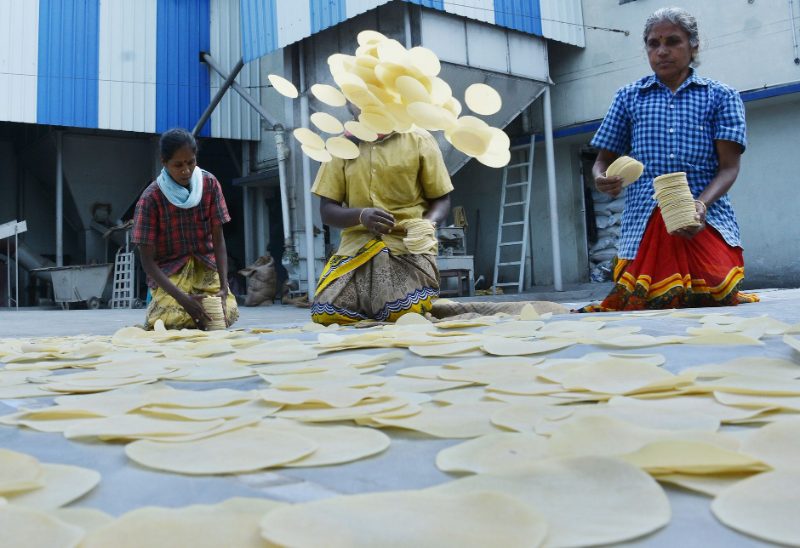
India’s food processing sector is projected to grow 25 per cent to nearly $600 billion by 2030, powered by artificial intelligence-led productivity gains and rising quick commerce adoption, according to a joint report by Deloitte India and FICCI released this month. The report, unveiled at FICCI FoodWorld India 2026, shows the industry shifting from a volume-driven model to a consumer-centric, AI-powered growth engine.
The findings come from Deloitte and the Federation of Indian Chambers of Commerce and Industry (FICCI), who studied how India’s roughly 12-per-cent food processing rate can scale rapidly as digital platforms reshape how consumers discover and buy packaged food. Up to 70 per cent of new food product launches are now digital-first, and 57 per cent of consumers rely on quick commerce apps to fulfil urgent grocery needs, the report found.
Why Is AI Becoming a Key Driver of India’s Food Processing Growth?
AI is being deployed across India’s food processing industry for demand forecasting, quality control, and formulation, helping manufacturers cut waste and respond faster to shifting consumer tastes. The Deloitte-FICCI report credits AI-linked productivity gains as a central reason the sector’s value is expected to climb toward $600 billion by 2030, even as the physical volume of processed food grows more slowly. Quick commerce platforms are compounding this effect: one in ten consumers now buy planned grocery items on qcom apps simply because of the convenience of ordering from home, pushing brands to optimise packaging, shelf life, and SKU design for rapid delivery.
What Does This Mean for the Wider Food Processing Industry?
The shift has sector-wide implications for manufacturers, cold-chain operators, and packaging suppliers. Demand is splitting between value-focused staples and premium, clearly labelled health-forward products, forcing FMCG majors and regional processors alike to run dual portfolios. Nutrition and functional food categories are growing roughly twice as fast as the broader food market, according to the report, pressuring smaller processors to invest in reformulation and digital-first launch strategies or risk losing shelf space to more agile, tech-enabled competitors.
Market Reaction and Industry Response
Industry leaders at FICCI FoodWorld India 2026 broadly welcomed the report’s findings, framing India’s low current processing rate as a long growth runway rather than a weakness. FICCI has pointed to complementary government efforts, including the Production Linked Incentive Scheme for Food Processing Industry (PLISFPI), which has already drawn cumulative investment of more than ₹9,000 crore and helped push sales of PLI-linked products up 10.58 per cent. Trade bodies are now urging processors to pair these incentives with AI adoption to capture export-led growth alongside domestic demand.
What Happens Next?
Watch for follow-through from the Ministry of Food Processing Industries as it works toward its stated goal of lifting the national food processing level to 25 per cent by 2031, up from 17 per cent in 2023. Expect more processors to announce AI and automation investments through the rest of 2026, alongside continued expansion of quick commerce grocery assortments, as companies race to capture the value-led growth phase Deloitte and FICCI describe.
Frequently Asked Questions
How big is India’s food processing industry expected to become by 2030?
According to the Deloitte-FICCI report, India’s food processing sector is projected to grow 25 per cent to reach nearly $600 billion in value by 2030, driven by AI adoption and quick commerce-led demand.
What role does quick commerce play in food processing growth?
Quick commerce platforms influence 57 per cent of consumers for urgent food needs and host 70 per cent of new digital-first product launches, pushing processors to redesign packaging and formulations for faster, smaller-format delivery.
What government schemes support India’s food processing sector?
The Production Linked Incentive Scheme for Food Processing Industry (PLISFPI) has attracted over ₹9,000 crore in cumulative investment and aims to boost processing capacity, exports, and employment through FY 2026-27.










Leave a comment